Pages

Showing posts with label Switzerland. Show all posts

Tuesday, April 5, 2011

Vacations without cars!


One of my favorite places in the world, Scuol Switzerland. You don't need a car as this photo shows ... it says: Engadin Scuol - for vacations without cars!

More photos of the Scuol Railway station, a wooden bridge and the great food we ate on my flickr set: Scuol Switzerland.

Thursday, April 1, 2010

Bern Switzerland Recommendations

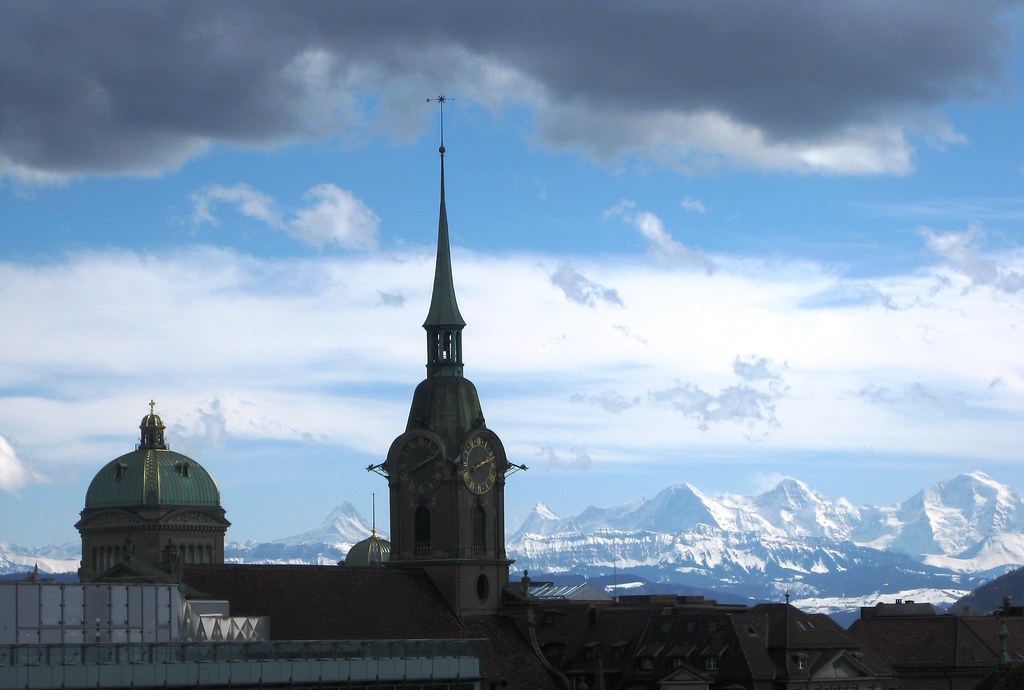
Bern rooftops and the Alps in the distance from the roof of Bern's main station (from my Bern flickr photos - click on any of the photos to enlarge).

We traveled to Bern often when we lived in Switzerland and recently visited to attend a conference. Here are some recommendations.

Bern is Switzerland's capitol and is less than an hour from Zurich by train. The train is a great way to travel: it's faster than driving and you can see exactly how Switzerland's "taktfahrplan" system works (it's a timed transfer system where all trains arrive in stations a few minutes before the hour - then passengers transfer between trains - then the trains all leave a few minutes after the hour). Here's some information on transport in Zurich and Switzerland from my website.

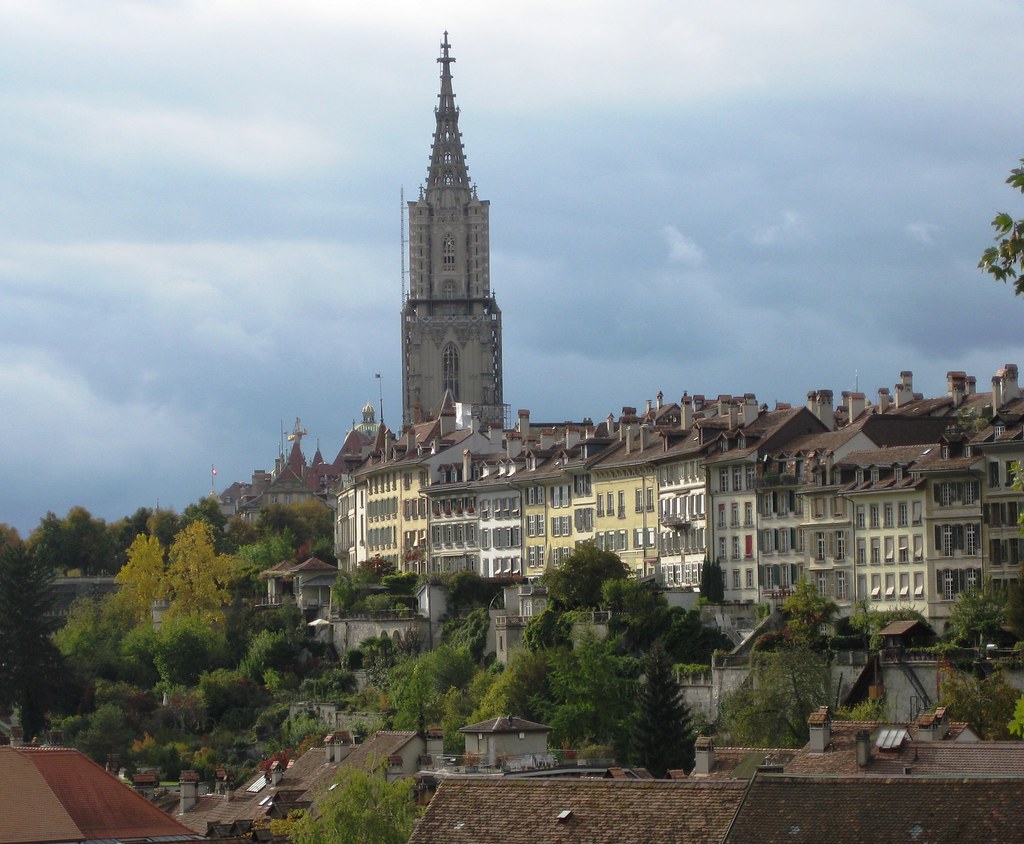
 Bern Cathederal and center city (shot near the Barengraben).
The Zurich - Bern route is especially interesting because to make the one-hour "takt" work, the SBB had to build a high speed section of track on the route. Now the non-stop trains take about 57 minutes - the high speed section was designed exactly to fit the one-hour takt. If you take the train, look around: there is a non-stop train every half hour and several local trains - and they are almost all full. The Swiss rail system is a great example of how creating an integrated network of high quality public transportation can get people out of their cars. But, back to Bern.
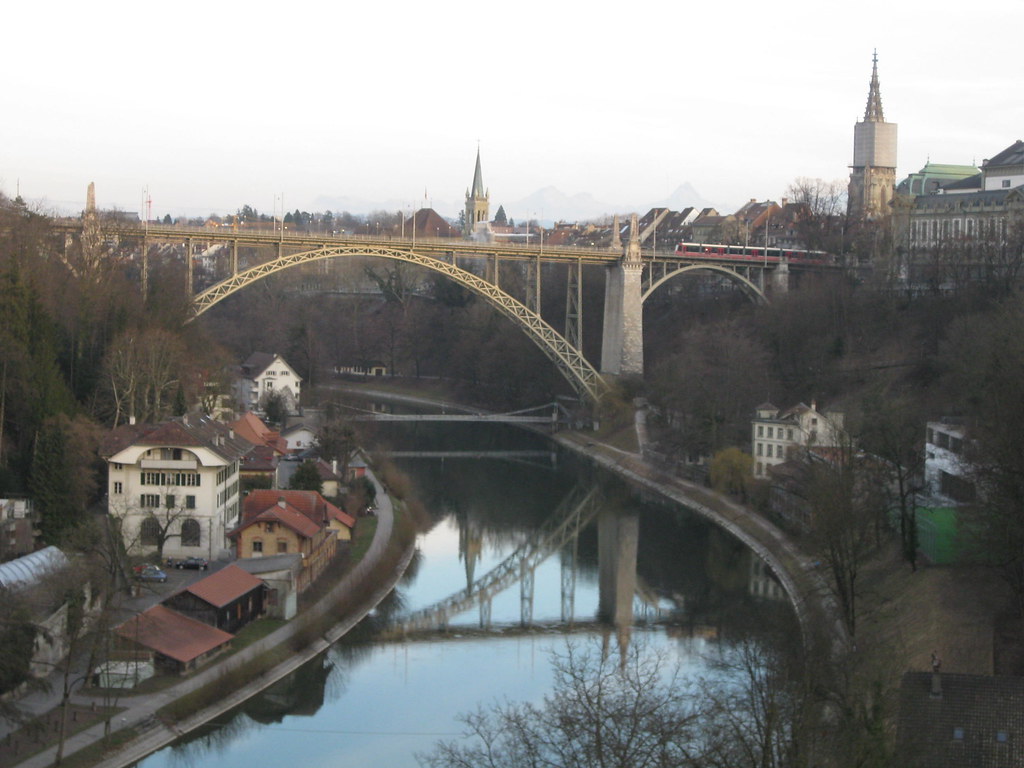
 Kornhaus Bridge in Bern (note the tram on the bridge and the Alps faintly in the background).
Bern's main train station is in the center of town. Like most Swiss rail stations Bern's is very busy. It's filled with stores (which, due to a special law, are open late and on Sundays - in contrast to most stores in Switzerland). From the main concourse you have two choices: go towards the city center or towards the parking garage.

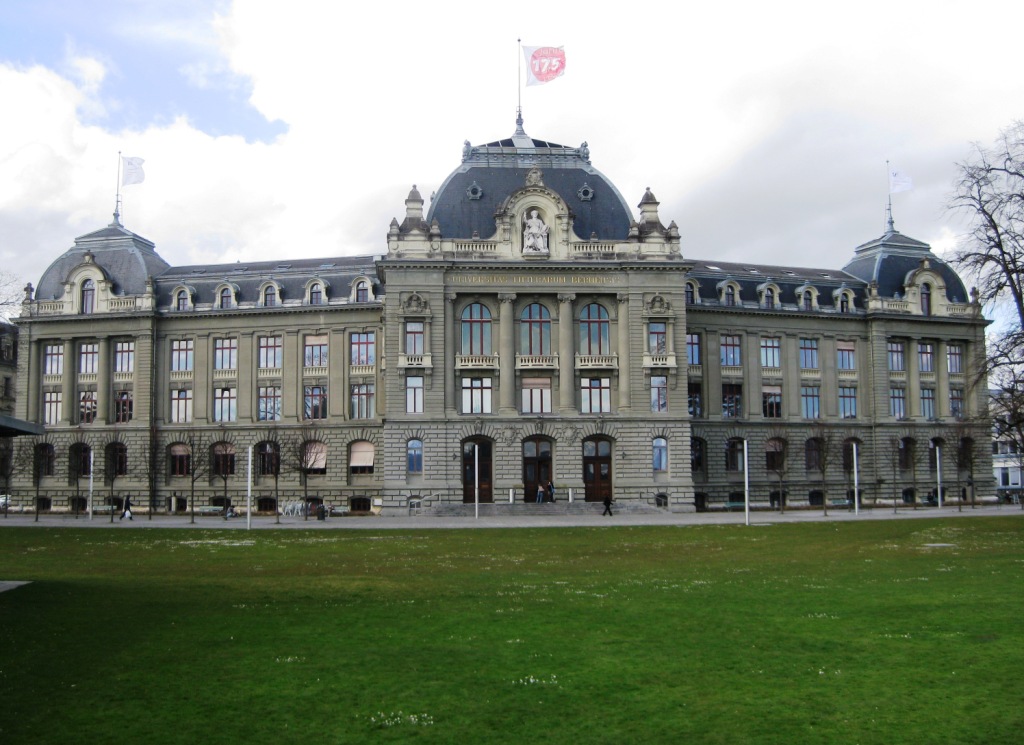
Surprise! First, go in the direction of the parking garage. A set of elevators will take you past the parking floors to the fourth floor: the elevators open onto a huge park called the Grosse Schanze in front Bern University's main building. This photo shows elevator building, cafe and university building (unobstructed view). In the other direction is a view over the city and if it's clear you'll be able to see the Alps in the distance (see top photo). There is a restaurant here which is pretty good, it's actually a cafeteria for the SBB workers, but Swiss cafeterias can be quite good.


The historic center of Bern is a UNESCO world heritage site. Much of it was built during the middle ages and it's filled with brightly painted fountains and cobblestone streets. The most noticeable feature are the arcades: there are continuous arcades on many of the central streets. The first level of these buildings is filled with stores, restaurants and cafes. There is a farmers market on Saturday in front of the Swiss Parliament and extending down some of the adjacent streets. The photo is behind the scenes at the market: coffee to go. The center of Bern is a wonderful place to wander around.

One of the highlights in Bern is the Zentrum Paul Klee. Klee grew up in Bern, became a teacher at the famous Bauhaus school in Germany, and then moved back to Bern. A large collection of Klee paintings was donated to the city on the condition that they build a museum for it. The Zentrum Paul Klee museum, designed by Renzo Piano, is a beautiful building with an undulating grass covered roof. The site overlooks the city and is easily reached by the #12 bus from the main train station (the museum is at the end of the line and so the buses say "Zentrum Paul Klee" on the front). The museum can be crowded so plan accordingly.

Also note that if you are coming on the train to Bern you can buy a combination ticket for the round-trip train ride, the local bus and the museum from your originating train station. Just ask for a "RailAway" ticket for the Zentrum Paul Klee (German only). Also note that RailAway (English) has lots of great rail ticket combination offers. These not only save you money, but also reduce the hassle of figuring out how to buy tickets and use local public transport systems (although using public transport is not difficult in Switzerland).

You can also walk to the museum, the city has recently created several "trails" through Bern connected with Paul Klee. The trails also take you to other Bern sights and have signs describing the connection with Klee. The sign at the right has a drawing Klee made when he was growing up showing the same perspective of the city as you can see.

We have three restaurant recommendations, although there are plenty of great places to eat in Bern. The first is the Altes Tram Depot, a modern microbrewery built into, well, an old tram depot. It's directly adjacent to the Barengraben: an open-air cage for bears (Bern's city symbol is the bear, you'll see bear images a lot in Bern). Right in front of the tram depot is the old bear pit, just looking at it makes you feel sorry for the bears kept there; but on the side is the newly completed bear area: a large expanse on the banks of the Aare River with its own river water. It's a huge improvement and another popular tourist site.

 New Barengraben in Bern.


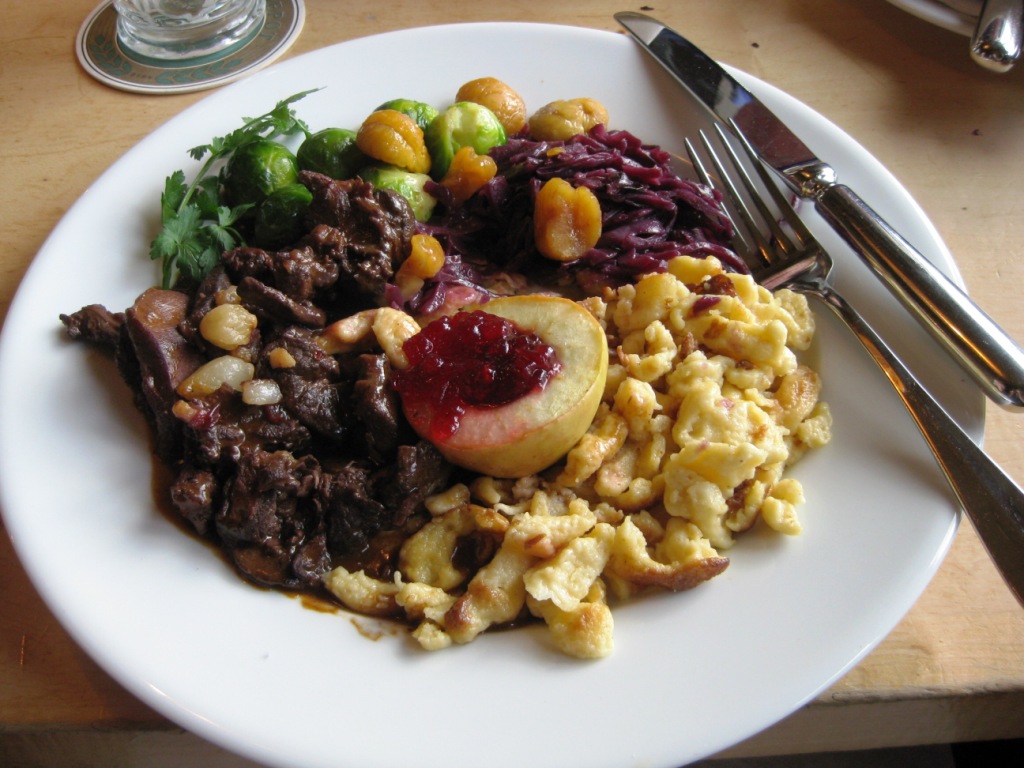
The Altes Tram Depot restaurant has traditional Swiss and "beer hall" food not to mention excellent beer. We have eaten here many times and it's always been good. Last time I had their wild (venison) shown in the photo, and our friends had Zurich geschnitzels (veal in cream sauce), Munich Weisswurst and spatzele - everything was tasty and high quality. It's a busy restaurant but service is quite good although it can get loud (after all it's a beer hall!). They have a wonderful terrace/ beer garden overlooking the Aare and historic center, it's a great place to have a beer and enjoy the view. (It's also on the #12 bus line to the Paul Klee Zentrum - bus stop: Barengraben).

On our last trip we had dinner in a wonderful restaurant called Brasserie Bollwerk. It overlooks the railway viaduct that leads into the Bern main station, so there's lots of trains going by (especially just before the hour and just after the hour, have you been paying attention?). They also have a nice terrace for outdoor dining, although it's on a busy corner so there is lots of automobile traffic. The restaurant is a member of Slow Food Switzerland and so much of the food is local and organic - they are also non-smoking! They have drawings from a local artist, the photo shows a set of postcards to help explain the local Bern dialect of German.

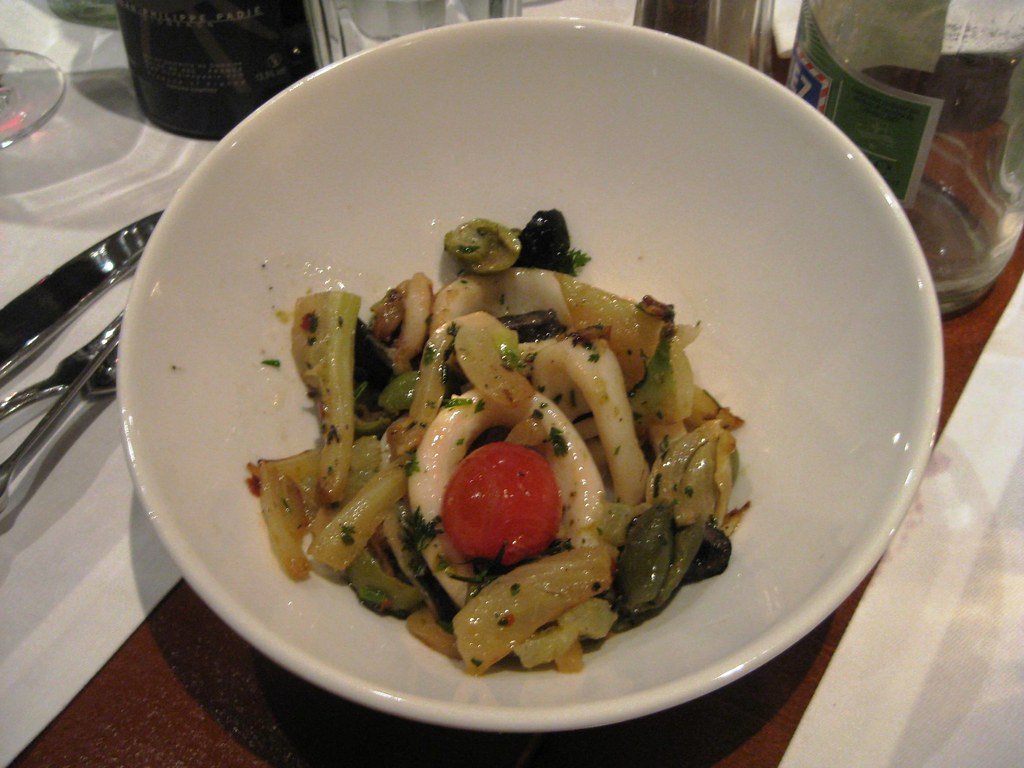
We started with a calamari and fennel dish (shown in the photo), then the special of the evening, a wonderful roast lamb (perfectly cooked) with potatoes and vegetables. Dessert was a really find chocolate mousse. They also had a wonderful Côtes du Roussillon wine that went perfectly with the food. The staff at Brasserie Bollwerk were friendly and efficient. They are open for lunch and dinner during the week.

Note that across the street in the ground floor of the rail station is the SBB Heritage Foundation library. This is not really a museum, but the historic archives of the Swiss National Railway. They often have small exhibits in the lobby area. They are only open on weekdays 9-12 and 13:30-17, and you need to ring the bell to visit.

We had lunch at another great restaurant called Moléson. One of my favorite foods is tarte flambée, the Alsacian pizza-like dish. I like the traditional version with creme frasche, muenster cheese, bacon and onions; Moléson's tarte flambée had a couple more ingredients, but was very tasty. The service could not have been better - they even let us substitute the traditional tarte flambée for the one on the daily special menu (a chicken-curry based model, maybe ala Wolfgang Puck's spicy chicken pizza, but, to me a bit of a travesty ...). We had a wonderful salad to start and coffee was served just right. The restaurant in the back looked excellent too (we ate in the front cafe). They also try to use local ingredients and organic food.

Sunday, March 21, 2010

Scoul Switzerland Recommendations


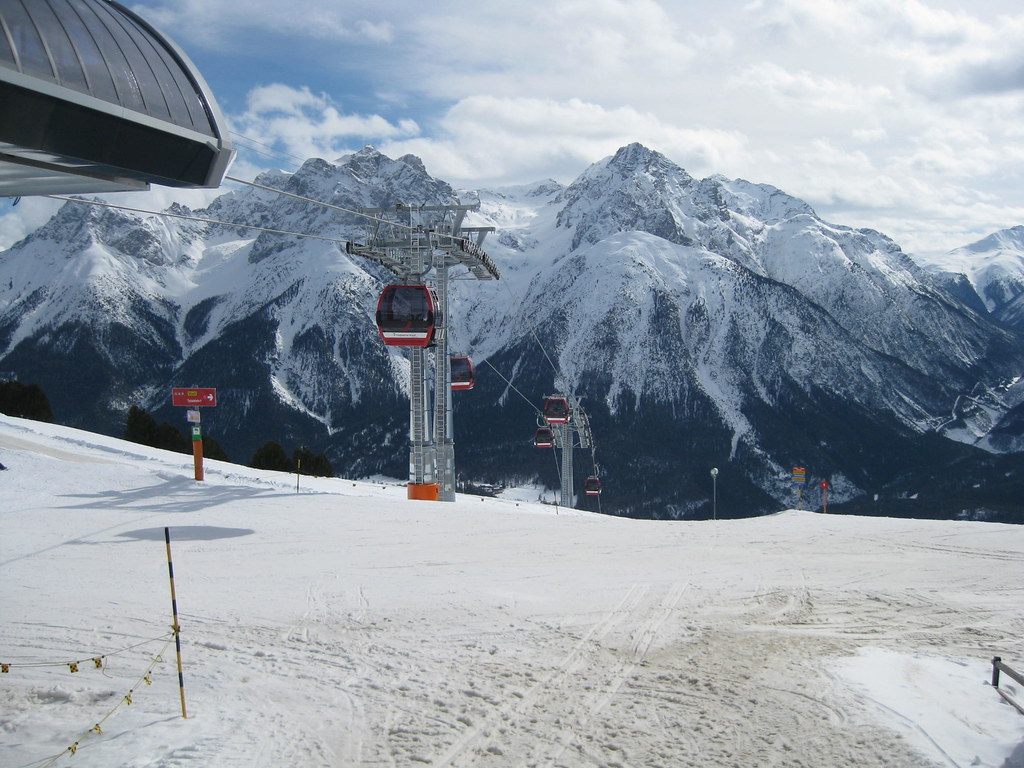
We returned to Scoul, one of our favorite places in Switzerland, for our ski holiday this year. The weather was great and the snow was fine. Scoul is about four hours from Zurich by railway. This post lists some of the reasons we love Scoul.

First, of course, is the Rhaetische Bahn; Scoul is the terminal station (shown in the photo above) at the southeastern end of the Engadine Valley (St Moritz is at the other end of the valley). The Rhaetische Bahn is a narrow gauge railway that serves the canton of Grabunden. It operates the famous Bernina Express and Glacier Express. This is a special year because the Bernina line is 100 years old. Anyway, the Rhaetische Bahn is exactly as you imagine a Swiss railroad: small red trains traveling through a magnificent landscape. If the weather had not been so good we would have taken a few joyrides over the Bernina Pass, but that will need to wait for this summer.

The skiing in Scoul is very good. Switzerland is spoiled for all the wonderful places to ski and Scoul, which would be on the top of the list in any other country, is not as popular as the more famous resorts. But, of course that has the positive side that it's a little less crowded and a little less expensive. The lifts are also a bit outdated (they have several Tee bars and old chairlifts in addition to the brand new gondola and a couple new chairlifts).

Another great reason to go to Scoul is the mineral bath. They have a relatively modern bath complex right in the middle of the town. My favorite part of the bath is the outdoor section with a view of the mountain peaks in the not so far distance (see the photo on their website). You can visit the bath for three hours (bring your own towel) or do something called the Roman-Irish bath, which is a two-and-a-half hour experience of going from sauna to massage to steam bath to different temperature mineral pools, followed by a half-hour rest. We've done both and they are highly recommended. You need to book the Roman-Irish bath in advance, see their website.

Scoul is a tourist destination and there are many places to eat and sleep. The old town down the hill from the main street, has wonderful historic architecture and traditional guest houses. The main street has several historic and modern hotels with all the comforts you would expect in Switzerland.


We have stayed at the Hotel Traube, an historic hotel, the Hotel Curuna, a very nice hotel with a very good breakfast, and Chasa Sofia, a four-room bed and breakfast that is out of this world. All three are located right in the center of Scoul, within five-minute walk of the bath.


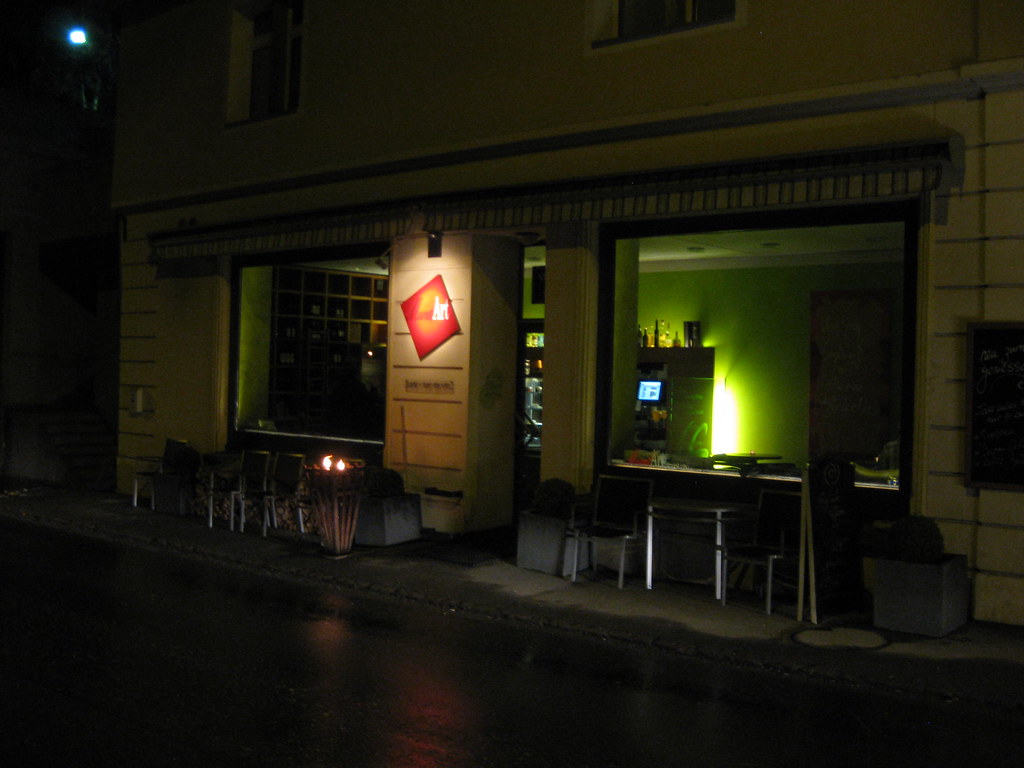
Finally there's lots of great food in Scoul. We visited a wonderful cafe on our trip in February: Mund Art. It's a great place for cake and coffee or a drink anytime (try the local beer: Biera Engiadinaisa). The people are wonderfully nice and friendly, the owner gave us a tasting of his homemade chili pepper syrup.

We had a wonderful dinner at the Hotel Traube restaurant (they also have Biera Engiadinaisa). Their wine list is superb, they probably have 50 different wines from the Canton of Grabunden; we had an excellent Pinot Noir (Blauburgunder) from Annatina Pelizzatti. We all had variations of venison (Wild), either steak (shown in the photo upper left) or stew with spatzele, one of my favorite wintertime mountain village dishes.


Finally, no trip to Scoul would be complete for us without a visit to the Pizzaria Giovanni adjacent to the Hotel Curuna. They have a wood-fired oven, use local organic ingredients where possible and have a wide variety of dishes beyond pizza, but the pizza is great. Service was a little scattered on our visit but the food was fine.


We can't wait until our next visit to Scoul!

Sunday, August 23, 2009

Swiss Travel System Video Contest - Bad News For Andy


Unfortunately my video entry for the Swiss Travel System Casting competition was not selected. Since I won't be heading to Switzerland, maybe somewhere else would be nice? Check out the video.

By the way, the Swiss Travel System Casting competition was lots of fun and congratulations to the winners! You'll really enjoy Switzerland and its fantastic travel system.

Thursday, July 30, 2009

Swiss Travel System Video Contest!


Here's my entry in the Swiss Travel System's video casting contest. Please take a look and rate the video highly ... extra points for those who know what I am alluding to ... send me a comment! Thanks, Andy

Saturday, July 4, 2009

Hallwylerhof restaurant Zurich


I recently had dinner with friends in Zurich at a restaurant called Hallwylerhof. It was updated Swiss food, very nicely prepared and served. The workers were also very friendly and nice. However, the decor caught my eye.

As many of you know I collect photos of WC signs (website coming soon - I hope). I think that it's one of the few places people can be creative these days ... some people at least.


The Hallwylerhof restaurant had a very whimsical design where many items were painted in a sort of primitive style on the walls, for example three framed old postcards from the Swiss mountains with a simple drawing in the middle of them that looked like a postcard.

Given the quality and whimsical-ness of these paintings I knew I was in for a treat when I went downstairs to the WC (no comments please!). And, sure enough, some of the best WC signs I have collected ... my flickr Hallwylerhof photos and all my flickr WC sign photos.

Hallwylerhof Restaurant and Bar: Hallwylerstrasse 43, 8004 Zurich, www.hallwylerhof.ch

Wednesday, June 3, 2009

Oh Lord, won't ya buy me a cobra tram?


Finally a new music video. Just before heading out to dinner with friends in Zurich I heard Janis Joplin's Mercedes Benz song. All I can say is that it was inspiring ... and I am not the only one, there's lots of versions on YouTube.

We went to dinner at a great little neighborhood restaurant with big windows on one of Zurich's public transport priority streets. All night long trams passed by until finally it clicked ...

Cobra trams are Zurich's new low floor streetcar. They were a bit undependable when they first arrived although seem to be doing well now. They are quite elegant: big windows, lots of room around the doors to move in and out, nice seats, clean lines and quiet. Their wheels are independent (in other words there is not a common axle between wheels on either side of the streetcar) which make them very quiet.

Unfortunately as the public transport vehicle manufacturing industry has consolidated over the last few years the major manufacturers have discontinued the "cobra" design, so Zurich's are unique. Here's a press release by the manufacturer Bombardier describing the cobra trams (PDF).

Thursday, April 16, 2009

Rainy Saturday on the Glattalbahn, Zurich


On our recent trip to Zürich we rode the Glattalbahn (German) from Zurich Airport into the center of Zürich. The Glattalbahn is a new rail line that combines aspects of a tram (streetcar, light rail transit) line with regional rail. It operates on the city streets in Zürich and then on its own right of way outside the city.

The Glattalbahn was very carefully planned and has lots of interesting features that you can see in this film including very well designed stations, sensitivity to the environment (tracks laid on grass, lines of trees), including the whole street in the improvement project and connectivity to other public transport. I hope the film does justice to some of these, sorry about the rain!

Zurich: Restaurant Karl


On our last trip to Zürich I had a great lunch at Restaurant Karl in the Zentrum Karl der Grosse, which is right next to the Grosse Munster.

The Zentrum Karl der Grosse is operated by the city of Zürich and offers a large variety of social and cultural programs. For example they have integration classes for immigrants, art programs and sometimes concerts. The restaurant offers training to disadvantaged persons and eating there helps support the programs.

We ate there several times when we lived in Zürich and the food was always very good. It's fairly simple: pastas, rosti and grilled meats. They offer a nice selection of wines by the glass, most from nearby (especially good are those from the Kloster Ittingen, which also brews a great Klosterbrau beer). An added bonus: it's smoke free ... still a rarity (unfortunately) in Zürich.

On this visit I was drawn in by the promise of Barlauch. Barlauch is something I never had in the USA, it's a spring herb that you make pesto out of, it's a natural garlic. I can't get enough of it (in fact we made five bottles of pesto last week). Anyway, I had it on top of the Zürich standby Rosti (home fried potatoes). It was fantastic, check out the photo. Although they did look at me a bit oddly when I asked for extra Barlauch, they brought me a nice little pitcher full. Lunch with water and coffee cost about 35 Swiss Francs.

Tuesday, February 24, 2009

Zurich: Kronenhalle Restaurant


We lived around the block from the Kronenhalle Restaurant in Zurich for about seven years, but although we visited the bar a few times, we never ate at the restaurant. Last week we took the plunge (well, actually, we were invited).

The Kronenhalle is one of Zurich's most famous restaurants. It was a meeting place for artists including James Joyce and Marc Chagall. Rumor has it that some artists paid for their meals in pictures and the owners were collectors. Consequently, the restaurant and bar are filled with excellent art.


The Kronenhalle is classic. Waiters in white, an elegantly dressed Maître d' and assistants in black with white aprons. One funny thing, especially if you are not from Zurich, is that they serve Burli rolls (I describe them here). These rolls are extremely crusty and, as you can see from the photo above, leave crumbs all over the white starched table cloth; but they are classic in Zurich.

We started with celery-chestnut cream soup and nussli salad (lambs' ear). The nussli salad was served with a nice french cream dressing; it's very popular in Switzerland. Both starters were excellent.

For our main courses my wife and I shared the rack of lamb for two and our companions shared the Chateaubriand for two. Both dishes were presented to the table, then taken to a carving station for plating.

They use an antique plate heating device that's a bit scary to see in operation, but elegant. The meal is served in two settings with fresh plates for the second helping. The meat and side dishes were cooked perfectly. We all ordered the profiteroles for dessert and they were also quite fine.


Since we were guests I can't say what the whole meal cost, but the prices, while high, are not significantly more expensive than in other Zurich restaurants especially considering the experience. The Maître d' said that the Zürcher Geschnetzeltes are the house speciality and they looked quite good. As a comparison Zürcher Geschnetzeltes cost 54 CHF at Kronenhalle versus about 40 CHF in many other restaurants.

Zurich Real Time Public Transport Information


As I have written before, the quality of Zurich's public transport system never ceases to amaze me. We visited last week for the International Association of Railway Operations Research (IAROR) conference and had a chance to catch-up with what they have been doing since we left. The biggest change for me is the real time public transport information systems.


All the new vehicles and most of the old vehicles have been outfitted with television monitors that display the next three stops, travel time to these stops and the final destination. Next to each stop all the connecting public transport lines are listed. That's pretty good, but it gets better.

As the bus or tram approaches a stop where there are connecting public transport lines, a second screen shows the departure time of the connecting lines and displays any delays for the particular line (see below). This gives you time to re-plan your route if something is delayed (although lines are seldom delayed in Zurich!).


The on-vehicle system is complimented by real time displays of bus and tram arrivals at all the main bus/tram stops and many of the smaller ones. The displays are simple and easy to read. These are very common today, but the extent of their deployment in Zurich is noteworthy.

As shown on the photo to the left, real time train information is also available on Zurich's S-Bahn (regional rail network), although the transfer of real time S-Bahn data to the Zurich city buses and trams did not seem to be working yet. It's probably only a question of time, the highly innovative and successful StadtbahnZug! S-Bahn system in Zug Switzerland was experimenting with providing local transit information in the trains several years ago.


I am not sure if Zurich's system is unique, but I have never seen a similar system so it might be. In any case it's an excellent example of providing real time public transport data. It's so good I am working on a parody music video of it, you'll see the video here first!

Friday, February 20, 2009

More Public Transport Announcements

My friend who was so impressed with Nice and the public transport announcements there wrote back to me when I asked if I could quote her, with the following:

Your note made me think a bit more about transit announcements, the fundamental question being, "Who should be speaking?" Is it the management of the transit service, as appears to be the default choice, deciding how it should be represented to the public? Is it the driver, who might be speaking if there weren't a recorded announcement? Or is it the community: specifically, the transit-rider part of the community? While of course professionals would have to make sure that most riders could understand the thing, I like the idea of the voice representing more of the actual participants in the transit experience, that is, either the driver or the riders.

All excellent questions I think.

Reflecting on the idea that the announcements should represent the actual participants in the transit experience I am reminded again of one of my favorite quotes (about half way down page) from Alain de Botton about Zurich and its public transport system ... essentially that everyone in the city from the Mayor to the very young school children use it. In which case the announcements would truly represent the entire community, a nice civic gesture.

Public Transport Announcements

I am preparing a post about Zurich's real time public transport information system, but here's another interesting item. A friend wrote to me from Nice:

How's this for a charming transportation refinement: I'm staying in the old city of Nice (not a bad town, either) five tram stops from the train station. As you get to the first seaside stop, the recorded stop announcement is followed by the sound of a wave breaking. The next stop is the opera house, which is announced in French and then in Italian. The next stop is the regional bus station, which is announced in French in then in English. Then they go back to announcing just in French. Cute, eh?

They have men and women's voices, young and old, changing for all five stops I've heard so far. Why NOT have an eight-year-old or an 80-year-old announcing the stops? I've always thought that the recorded announcements in San Francisco should use men's voices with the local black San Francisco accent because that's who drives the bus, instead of woman-like machine voices from Ohio somewhere, but I like this idea even better.

I think this is a great idea. Not only does the variation in voices and audio clues (wave breaking) add some creativity but it also helps remind you where you are in the city. The WienerLinien (Vienna's public transport operator) had a recording come on between two stations of a child asking you not to leave your newspapers in the trains. I loved hearing it because it was so different and unexpected (even though I heard it between the same two stations every day!). By the way, after being asked so nicely I never left my newspaper again.

Friday, September 19, 2008

Future of Railway Service - in German!

Yesterday I had an interesting experience: I was interviewed in German on the Swiss national radio station DRS. They asked me questions about the future of rail service - a topic close to my heart. I offered to do the interview in English, but the interviewer said my German was fine - I felt great!

I think they hoped that I would present really different ideas like magnetic levitation trains (maglev) or other 'visions' for the future. But I didn't. My opinion is that by applying "social innovation" to railway systems we can really improve our transport systems. We don't need significantly faster rail technology, we need to make existing rail travel easier, more comfortable and slightly faster (i.e. apply high speed rail technology). High speed rail should be the transport mode of choice for trips less than 600 km, flying for trips greater than 800 km, and, for trips in between, people should choose based on the specific circumstances.

Monday, September 8, 2008

Kurhaus Bergün, Switzerland


On our way back to Zurich from Poschiavo we stopped in the village of Bergün (German). It's located on the Abula line of the RhB - Rhätische Bahn. A friend had recommended that we visit the Kurhaus Bergün (German). The hotel is about a five-minute walk from the train station.

A Kurhaus is a hotel where you go for a "cure" or rest. Most of them are associated with mineral baths, medical treatments or simply relaxing for a couple of weeks in a natural environment. It's a pretty nice idea.

The Kurhaus Bergün is a beautiful Jugendstil building built between 1905-06 by the Zurich architects Jost-Franz Huwyler-Boller (who also built several other famous hotels). The hotel seems to have fallen on hard times and a group of regular customers decided to try and save it. They are restoring the hotel slowly and the work so far is really excellent.

We decided to have lunch on the sunny balcony (overlooking mountains). The restaurant has a relatively limited selection, but the food is "bio" and comes from suppliers in the region. I had a wonderful "toast". In most places a toast is like a grilled cheese wonder bread sandwich, but not here ... tangy mountain cheese served between two thick slices of homemade whole grain bread ... shows how good simple food can taste when you use quality ingredients. I washed it down with a Monstein Hausbeer (the Monstein Brewery is located in the adjacent valley near Davos). It was a great lunch.


Bergün is the start/end of the Abula railway history trail up to Preda. The Abula line was declared a UNESCO World Cultural Heritage site in 2008. The trail has panels describing how the Abula rail line was built. It is a fun, although fairly strenuous, hike. The best idea is to start in Preda - then it's downhill to Bergün. They are also building a railway museum at the Bergün (German, very nice website with information about the Abula line) station but I am not sure when it will open.

There is also a ski lift in Bergün and swimming pool. The skiing looks like it would be good, but it's not a large area by Swiss standards. Another unique attraction in the winter is sledding from Preda to Bergün (German). They close the road, well, snow actually closes the road, and place hay bales on the worst curves, you rent a sled at the RHB railway station in Preda then sled down to Bergün. It's quite a trip. The Swiss National Railroad's Railaway program has special offers for people who want to make this trip.

All in all, Bergün has a lot to offer.

Here's a video of the sled ride!


Hiking and Eating in Poschiavo Switzerland


One of our favorite places to visit is Poschiavo Switzerland. Poschiavo is about four and a half hours from Zurich (on the train!) in the south east corner of the country. To get there you go to Chur on the standard gauge SBB (national railway) and then transfer to the narrow gauge Rhaetische Bahn (RhB) railway. You take the RhB through the Abula Pass to the Engardine Valley, then transfer to another RhB train that takes you over the Bernina Pass. It's a railway junkie's dream.

In 2008 UNESCO declared part of the Abula rail line a UNESCO World Culture Site. The RhB have done an excellent job developing creative new services and promoting rail travel. For example there is a history trail along a particularly complicated portion of the Abula line. Many railways could learn from their high quality and creative approach to the railway business (but that's for another post).

The train continues south from Poschiavo to Tirano Italy (the Valtellina Valley). People in Poschiavo speak Italian and the valley combines the best of Italy and Switzerland in much the same way as the more well known Canton of Ticino.


We stay in the Hotel Albrigi located on the main square of Poschiavo. On our first trip we met the owner (Claudio Zanolari) and he made such a great impression we have been back many times since then. The Hotel Albrigi is a historic hotel, it has only about 10 rooms and the bathrooms are on the hall. It's not for everyone (but the family also operates the Hotel Croce Bianca, which is more modern).

The food at the Hotel Albrigi is excellent, even if you don't stay in the hotel do eat there! They make wonderful pizzas (wood burning oven), great local specialties (more in another post), and excellent meat dishes. The local wine - mostly from the Valtline Valley of Italy - is great. We often start with a pizza to share and then move on to the main courses. There are tables on the square and that's a wonderful place to eat at midday and on warm nights.

Poschiavo is an excellent place to use as a base for hiking trips. This year we made three all day hikes and one short hike. Since this is Switzerland, you can take public transport (Post Bus or RhB) to most of the trail heads fairly easily from Poschiavo, but you need to reserve in advance for some of the Post Bus lines (people at your hotel or the friendly tourist office - in the train station - can help you with this).


The first day we took the RhB train to Bernina Diavolezza. This is a ski resort in the winter and there is a cable car that takes you up the mountain to an elevation of 2,977 m (or 9,768ft). Then you hike about one and a half hours to the summit where you have a panoramic view of the Engardine and Bernina valleys - plus more mountain peaks than you can count. There is a good restaurant at the top of the cable car and if you stay in the hotel you can even take a hot tub bath (German) there overlooking the mountains.


On our second hike, we walked up the mountain from the Cavaglia RhB station to the Alp Grün RHB station. It's a short but strenuous hike uphill but the Alp Grün Albergo Ristorante at the top is warm and welcoming (watch out for the automatic door to the balcony overlooking the valley!). Many visitors are railway fans and they have an assortment of postcards and information. You can also stay overnight there. We were able to take one of the RhB's open wagon sightseeing cars down from Alp Grüm to Tirano, here I am enjoying the trip!


On Thursday we took a long hike to the San Romerio Alp. It took about seven hours walking (some strenuous) and a couple hours relaxing over lunch on the Alp. There is a very nice mountain church on the Alp and a guesthouse on the San Romerio Alp (Italian, German also available). It's best to get to the guest house early since if they are busy they run out of the specials. The food is mostly cheese and cold meat with bread, but you can order some of the regional specialties (e.g pizzoccheri) if you call in advance. You can also stay there overnight.


The church was locked when we arrived, but there were two children, probably no more than four or five years old, playing nearby. When they saw that we wanted to visit the church they ran off and brought the key, opened the door, then ran through the church showing us all the nooks and crannies.


They spoke Italian, and so most of the communication was their running around pointing excitedly. They ran up to the bell tower and started ringing the bell, then down to the crypt and then out the door. I was worried for a minute that they might lock us in, but they were just outside having returned to playing.

Our last hike was to the really beautiful Val di Campo. Again, we took the bus from Poschiavo on the main road over the Bernina Pass to a guest house at the beginning of a small road leading into the valley. There we transferred to a smaller bus (this is the one that requires reservations) and took this bus to the end of the line (another guest house - see photo).


From here it's a relatively short walk up to a beautiful lake, then you can take a more strenuous hike further to the border of Italy and return to the lake through another valley. We had beautiful weather and enjoyed a relaxing (very) late lunch at the guest house before walking back out to the main road (about 1.5 hours, but downhill so no need for the bus).


And, then, our holiday for this year was over. But we hope to return soon!

CERN Superconductor Video Rap

I just saw this music video on what the new supercollider at CERN is supposed to do (it was on a Wired Blog posting) of the top 10 physics videos. Finally, science presented in a way I can understand. Here's Wired's explanation of what happens in the LHC and what theories they hope to understand better and, here is the video - I just hope that the dancers don't give up their day jobs:


Friday, April 25, 2008

Best Transportation Photos


Wired magazine is having a contest for best transport photos and that gave me the incentive to create a set of my best and put it on my flickr site.

The photos are simply ones that I like, some are kind of arty but most are just interesting (at least to me). Here's a link to the set. The photo above is of the lighthouse at the entrance to Buffalo NY harbor.

Saturday, April 12, 2008

Pizzoccheri della Valtellina


On Thursday I cooked one of our favorite recipes: Pizzoccheri della Valtellina. Valtellina is a valley in northern Italy along the border of Switzerland. I'll discuss it again in a future post.

Pizzocheri is an "Eintopf" dish in the sense that it is (mostly) cooked in a single pot. It is one of those very hearty Alpine dishes designed to keep the shepherds warm and well fed using easily available food. The photo above (sorry for the dark quality) is Pizzoccheri we enjoyed at the Croce Bianca Hotel in Poschiavo Switzerland. Everyone has their own recipe, notice the carrots in the photo, but enough talking, here's my recipe, feel free to be creative:

Ingredients

  • 1 pound buckwheat noodles, use flat, wide (1 cm wide), short (6 cm long) noodles for best results;
  • 1/2 pound potatoes;
  • 1 pound mountain cheese (e.g. as strong as you can stand: Appenzeller, Gruyere are great);
  • 4 ounces bacon (spec) diced small;
  • 1 pound onions sliced;
  • 4 cloves garlic (or more if you like);
  • 1 pound spinach;
  • Crushed peppercorns to taste (I use 1-2 ounces);
  • Salt, olive oil;

Directions
  1. Place sliced onions, bacon, olive oil in large (12-quart) Dutch oven pan (non-stick best), cook at medium heat stirring frequently, add salt and pepper as you cook;
  2. In another large pot boil about 8 quarts of water;
  3. Peel potatoes, cut into 1/2 inch cubes;
  4. Place potatoes in boiling water, cook for about 5-minutes;
  5. Place buckwheat noodles in boiling water (with potatoes), cook for about 10 more minutes;
  6. While noodles are cooking grate the cheese (note this is a good opportunity to get rid of all your old cheese, use whatever you have on hand);
  7. Taste noodles, when they are almost done add the spinach;
  8. Stir the mixture constantly, taste the noodles and when they are done drain most of the water;
  9. Add the potato-noodle-spinach mixture to the onion-bacon mixture, stir carefully so as to not smush the potatoes too much;
  10. Add the grated cheese to the mixture, again stirring it carefully;
  11. Add a bit of the noodle cooking water to the mixture;
  12. Cover the pan and let it settle for a few minutes;
  13. Serve in pasta bowls.
Enjoy!