Pages

Showing posts with label railway innovation. Show all posts

Thursday, July 8, 2010

Urban Track Final Conference 2010

 Czech Pendolino train in Prague main station.

I went to the Urban Track Project final conference in Prague because I am helping the Wiener Linien (Vienna’s public transport operator) on a research project intended to better understand the motivation for implementing good maintenance procedures. The conference presented results of the four year research project on how to design and build better urban rail (streetcars, metro, subway, etc.) track work. Several of the presentations were about how to design slab track to reduce noise and vibration.

Since I am more of a planner than engineer a couple of the less track-engineering presentations were more interesting for me. These were on: green track, rehabilitation processes and socio-economic impacts of rehabilitation projects.


Brussels Public Transport 25apr10-06

Green Tram Tracks on Avenue Louise in Brussels (from my flickr photos)

The Green Tram Tracks, The Advantages of Implementing Vegetation Systems in Tram Tracks presentation was by Henrikje Schreiter from the Institute of Agricultural and Urban Ecological Projects (IASP) in Berlin. She described her phd dissertation on the benefits of using a specific plant species (Sedum, which is a succulant plant) for green tracks. In summary, there are a lot of benefits including water retention, reducing noise (small, but something), reducing airborne particles and just creating a nice visual environment. She discussed lots of the practical reasons why Sedum is a good choice (e.g no need for mowing) and how you actually build these systems (e.g. building them so that emergency vehicles can drive over them).


The IASP is holding a seminar on the subject of green tracks (German) – who knew that Berlin has been using green tracks since the early 1900s? – on 20 September 2010 (before the Innotrans Exhibition). The seminar is in German, but I may try to go and can do some translation of interesting presentations.
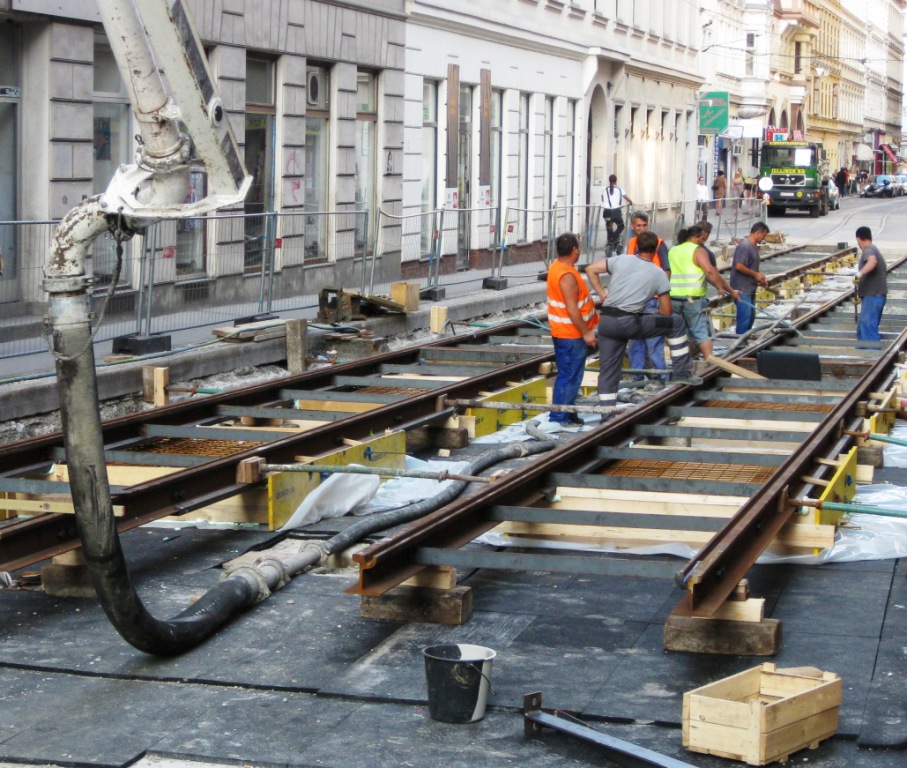


Several speakers talked about rehabilitation of tram tracks. As visitors to my website and YouTube channel know, tram track rehabilitation is a subject close to my heart! Speakers described a replacement project in Bremen where the tram service was only stopped for a weekend (although roadway traffic on the adjoining lanes was stopped for four weeks) for a traditional tram track replacement project, and one in Karlsruhe, where the city took about three weeks to install pre-fabricated track slabs in a historic district.


The contrast between the two projects was quite interesting. In Bremen the goal was to minimize service disruption and in Karlsruhe the goal was to install historic-looking track as efficiently as possible. In the project area Karlsruhe’s track is set in cobble stone pavement, so the prefabricated sections had a cobble stone surface. Also interesting was the fact that the work was done under the catenary lines – which made it difficult to maneuver cranes and lifting equipment. Both projects were partly funded by the Urban Track project and lots of practical lessons were learned.


The final presentation I will talk about was by Marjolein de Jong from Hasselt University in Belgium. The presentation was on evaluating the socio-economic impacts of tram track rehabilitation projects. What I found so interesting about her research was how systematically she identified the potential impacts and her findings regarding various potential staging strategies. When I talked to her later she said, well it’s just impact analysis 101, but I think it’s important because it starts to develop an organized framework for thinking about some of the problems planners face when considering rehabilitation programs.


More information about the UrbanTrack project is available at the UITP website.

Saturday, December 19, 2009

ITS Berkeley California High Speed Rail System Seminar - Videos

In October I blogged about the California High Speed Rail seminar organized by UC Berkeley's Institute of Transportation Studies. The seminar was videotaped and the tapes are available from the ITS News Bits website.

Tuesday, August 11, 2009

Moving Sidewalks: Back to the Future?


There's a great article on the history of moving sidewalks in New Scientist Magazine (thanks to Planetizen).

I think moving sidewalks, or some other type of continuous transport system, would be a great feeder system for regional (US: commuter) rail systems. This would enable the stations to be located a bit further apart in urban areas than in a 'normal' subway system - reducing operating costs and making service on the regional system more attractive (fewer stations = faster). Regional rail systems build with this model could follow the Zürich S-Bahn model, many lines operating through a central section that branch to different suburbs when they leave the center.

An interesting compliment to the moving sidewalk/continuous transport system would be combining it with attractive urban design, in other words give the people traveling on the system something interesting to look at while traveling. I recently had the idea of creating such a system in Abu Dhabi as part of their new Metro project. In this case the continuous system could travel through a traditional Arab linear market street setting. The market street would be protected from the weather in traditional ways, thus reducing energy use. The project would combine 'new' urban development with the transport system. More on this idea later.

Wednesday, April 29, 2009

Railways in Wired's Today in Tech


Wired has a fun blog called This Day in Tech. It describes some invention or idea that was first deployed on the same day sometime in the past. Today's was on the invention of the automatic coupler for railways.

When we talk about how good the European railways are, it's interesting to remember that Europe still uses the old manual method of coupling which makes their railways much less efficient. I heard that Europe was about to change to automatic couplers in the 1970s, but France vetoed the idea for some odd reason. C'est la vie!

Here's a list of some of the other railway related This Day in Tech postings:

Aug. 2, 1873: San Francisco’s First Cable Car Conquers Nob Hill - Describes the first cable car in San Francisco and how the system works.

March 5, 1872: Westinghouse Gives Railroads a Brake - Describes how air brake systems work, the air brake 2.0 reference provides a nice perspective on technological innovation.

Nov. 18, 1883: Railroad Time Goes Coast to Coast - who knew that the idea of standard time started with the railways, but it makes sense when you think about it.

Wednesday, April 22, 2009

Future Urban Transport Conference - Days 2 and 3


Yesterday I discussed the academic workshop held at the Future Urban Transport Conference, today I discuss the second two days which were devoted to a wider discussion of issues.

On Monday, we started with presentations from very high level business leaders at AB Volvo, Bombardier Transportation, Volvo Car Corporation and the Swedish Petroleum Institute. They described what their companies were doing in the areas of future urban transport. Next we heard from the Mayor of Goteborg, the Deputy Mayor of Changsha (China) and Kulveer Ranger (Director of Transport Policy for the Greater London Authority). They described how their cities were addressing the issue of sustainable transport and urban planning. The final session discussed 'service' business ideas: urban freight management, Veolia Transport (a major operator of public transport services) and a property developer from Stockholm who described how they redeveloped an old industrial area.

All the presentations were interesting, although I think that the discussion would have been better if the groups were mixed rather than in the "silo" based format. For example it would have been interesting to have the Bombardier's president discuss where and when rail investment is warranted with a policy maker from a developing country in Asia or Africa. Or having the Volvo Cars president discuss with London's transport policy director how to make electric cars a reality (London believes electric car technology is ready for deployment now, it would have been interesting to hear the auto industry's view on that).

On the other hand, the conference was small enough so that we could discuss many of these issues on a one-to-one basis. In fact, I discussed Shai Agassi's very interesting Better Place proposal for deploying electric cars NOW with London's Mr Ranger the evening before over a beer.

We started Tuesday with two videos of James Bond in Bremen. Then four focused discussions of specific research projects sponsored by the VREF. Professor Lisa Schweitzer (University of Southern California) talked about the need to proactively work on development around rail stations in disadvantaged areas. Professor Yves Crozet (University of Lyon) described how to improve accessibility for disadvantaged areas by focusing on slower modes of transport based on a case study of Lyon's BRT line (the case study used a very cool GIS analysis).

Next we heard from Professor Anthony May (University of Leeds) on the results of a quick analysis of transport financing in France, Germany, Great Britain and Japan. What was most surprising was the lack of detailed research in the area of comparing these systems and the high degree of variation. (This would be an excellent subject for my WIKI-based transport knowledge management system, more later.) Finally, Professor Elizabeth Deakin (UC Berkeley), another of my favorite UCB professors, talked about the US transport funding situation. Both presentations included several excellent recommendations for improving the funding process.

In the afternoon a small group of us visited the Volvo Museum and learned a bit more about the Volvo buses. More tomorrow.

Future Urban Transport Conference - Göteborg Sweden


I just returned from the 4th Future Urban Transport Conference held in Göteborg. The conference is sponsored by the City of Göteborg, the Volvo Research and Education Foundations and the Volvo company. (The photo above is of the design on the sides of Göteborg's public transport vehicles - they have a great PT system including a new bus rapid transit line.)

The conference was excellent, blending academic research with public policy and business issues. The first day consisted of presentations from academic researchers. Many were from programs sponsored by the VREF and there was a real diversity of ideas and opinions expressed. The conference website shows the schedule with links to the presentations.

One of the most interesting presentations for me was the keynote by Professor Geetam Tiwari who discussed some of the research done at her institute in New Delhi. Her presentation Public Transport Use - Emerging Issues really made you think about some preconceived ideas about public transport (is a new metro the right solution for cities like Delhi? is public transport really safer than alternatives? what are the real equity issues in transport?).

I also really enjoyed Professor Carlos Daganzo's presentation on A Cheap and Resilient Approach to Eliminating Bus Bunching. Professor Daganzo was one of my teachers at Berkeley and he always amazed me by being able to translate very complex mathematical analysis into practical ideas, and even better, to make them easily understandable. As a public transport rider I feel like I am affected by bus bunching every day and so I hope to work with Vienna Transport to test Carlos' idea on my local bus line. I'll keep you updated.

The third presentation that made a big impact on me was by Professor Harry Dimitriou: Mega transport Projects, Globalization and Private Finance: Emerging Challenges for the 21st Century. The topics he raised are especially topical since many policy makers have been operating under the assumption that private finance (e.g. public private partnerships etc.) are the answer to solving our transport infrastructure problems ... but the private finance model seems to have let us down in the last several years, what does this mean? Among the interesting points he made is that the private sector is not necessarily more efficient than the public sector, that finance companies and government can have very different objectives for their assets (financiers may want to churn the asset to generate short term profits, government wants an efficient and sustainable infrastructure solution), etc. Fascinating ideas extremely relevant for today's problems.

I could go on since there were many other interesting papers and discussions. Tomorrow more on the second two days of the conference.

Thursday, April 16, 2009

Rainy Saturday on the Glattalbahn, Zurich


On our recent trip to Zürich we rode the Glattalbahn (German) from Zurich Airport into the center of Zürich. The Glattalbahn is a new rail line that combines aspects of a tram (streetcar, light rail transit) line with regional rail. It operates on the city streets in Zürich and then on its own right of way outside the city.

The Glattalbahn was very carefully planned and has lots of interesting features that you can see in this film including very well designed stations, sensitivity to the environment (tracks laid on grass, lines of trees), including the whole street in the improvement project and connectivity to other public transport. I hope the film does justice to some of these, sorry about the rain!

Saturday, March 7, 2009

Brûlé: Rail Transport Quality and Market Streets


Tyler Brûlé's weekly column in the Financial Times today World-class city or grim ghost town? addresses two of my favorite subjects: quality in rail transport and vacant storefronts on shopping streets.


First, transport. Brûlé is right-on in his questions about EuroStar and Belgium's rail stations. My favorite Belgium railway story is that in the International Airport - picture thousands of people coming from all over Europe every day to do EU business - the automated ticket machines don't take credit cards (photo above is of the ticket machine, photo on right is of the lines waiting to buy tickets - note they don't even use customer-friendly queuing system).

You can use your VISA card to buy gasoline at every gas station in the world ... when will railways learn?

By the way, I've written a song about the railway ticket machines, music video coming soon!

Second, empty storefronts. Again, Brûlé raises some interesting questions as he praises the large number of home-grown businesses on Lisbon's shopping streets. I have always thought that landlords are short-sited when they throw out solid local businesses in favour of chain stores.

But, crisis brings opportunities. We need to develop business models, call them market 2.0 streets. These streets would be managed using a cooperative approach: say one chain store, five local businesses with the six landlords sharing the profits. Add-in ideas like locally-based programming, extra cleaning and more safety - paid for jointly by the cooperative and we may be on to something.

Better yet, cheap storefronts on these streets for local businesses would be incubators - helping creative people to develop new ideas and products ... real products and services that people need. Could these market 2.0 streets be a path out of today's economic problems?