Here's a fine article "Our Waterfront, Ourselves" by Bruce Fisher about what to do when a large big box retailer pulls out of a waterfront development project. This has been a shock to Buffalo's planning and development community - providing for lots of discussion and questions (be sure to read the comments).
An excellent feature is that Fisher starts from the - should be obvious - point that the Buffalo area is shrinking and therefore whatever is done needs to be quite different from what's done in growing regions. Hmmm... why don't we ever think this way in planning school?
Too many cities chase the chimeras de jour - festival marketplaces, downtown ball parks, convention centers, casinos, ... all big plans that capture the imagination but fail to spur city economies.
In this context Fisher's suggestion that funds be spent to clean up the water, increase public access and encourage local initiatives rather than subsidizing big box retail and parking make lots of sense.
Fisher's article is refreshing as both planning theory and in Buffalo's public debate over this important issue.
Showing posts with label environment. Show all posts
Showing posts with label environment. Show all posts
Tuesday, September 14, 2010


Thursday, November 19, 2009
Web 2.0 and California High Speed Rail Planning
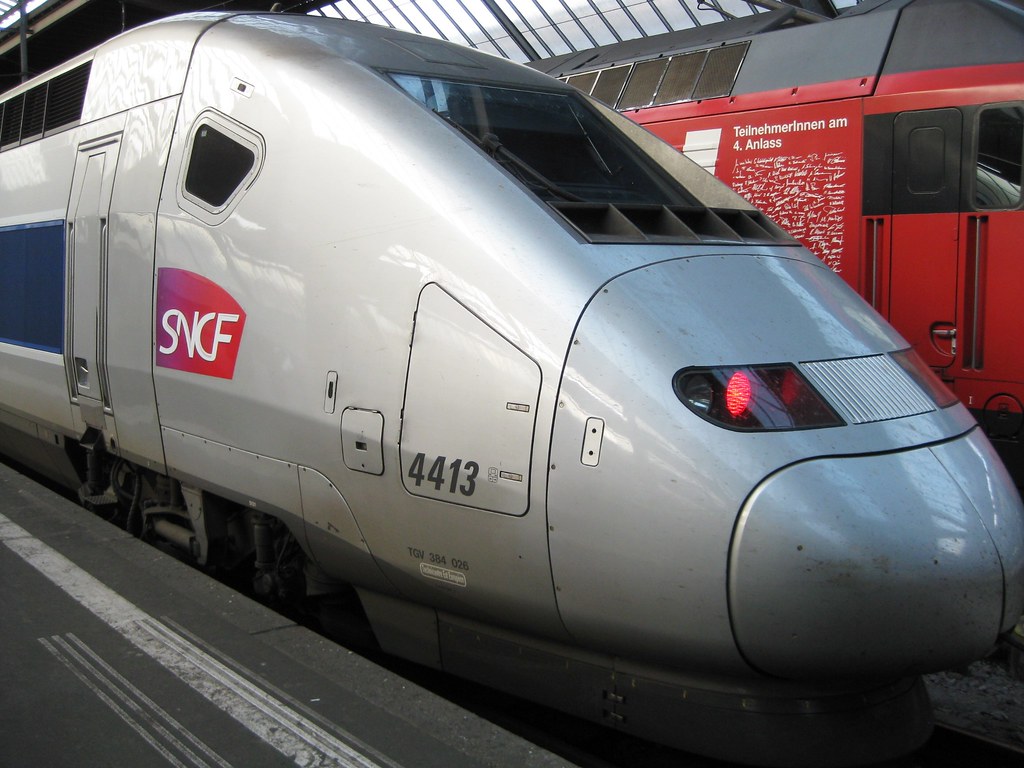
TGV at Zurich Hauptbahnhof - October 2009 - from my flickr photos.
As I mentioned in a previous post, I just finished revising my TRB paper on Web 2.0 applications for improving public participation in the transportation planning process (download here: web2transport). Yesterday I was talking to someone about some of the ideas in the paper and I remembered a story I wrote in 2005 as part of a proposal for completing the Regional Rail Plan for the San Francisco Bay Area.
The story was a speech given by one of the participants in the Regional Rail Plan planning process given 25-years after completion of the California High Speed rail system. I just re-read the story and I was surprised about how good it is and how relevant so many of the points it raises are today. So, here's the link to a pdf file. As they say, sit back, relax and enjoy the trip!
San Francisco Bay Area Regional Rail Plan - A vision (2005)
(By the way, although people I talked with on the inside said that this story was an important reason for selecting the consultant team, the consultants never asked me to help with the project and I'm not sure what ever happened to the plan itself.)
Friday, October 23, 2009
The future of automobiles - A3PS Conference Vienna
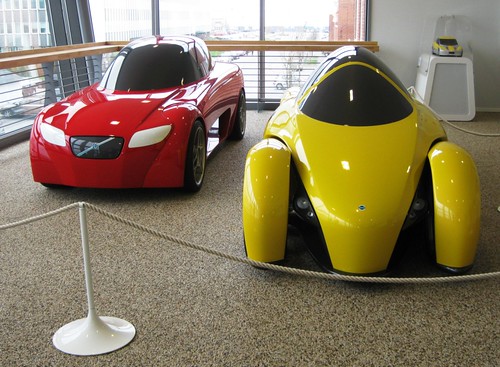
Concept cars at Volvo Museum in Goteborg Sweden - from my flickr photos.
Last week I attended a fascinating conference organized by the Austrian Agency for Alternative Propulsion Systems (A3PS). The A3PS is a quasi governmental agency that supports research in new propulsion systems. They are oriented to automobile propulsion since Austria is a net exporter of automotive products, especially drive trains.
The day consisted of five keynote presentations and then several parallel sessions where Austrian research groups presented results of their research in electric mobility, fuel cells and alternative fuels. A total of 19 different research projects were discussed. Most interesting for me were the keynote presentations by Karl Rose from Shell oil, Remi Bastin from Renault and Peter Froeschle from Daimler.
Karl Rose, who works on strategy development for Shell Oil, made several very interesting points. First, he criticized the "cycles of hype" in alternative energy, namely everyone goes crazy over one type of alternative energy (think hydrogen fuel cells several years ago and now electric cars) for a while then forgets about it and picks another form to hype.
Rose believes that there are three hard truths facing the energy market: (1) a surge in demand as world population and development continue (especially for electricity); (2) supplying this increase in demand will be difficult; (3) environmental concerns are becoming more critical. These truths create a complex situation for government policy and businesses. He sees two approaches: a Scramble World (where countries scramble to secure energy resources leading to a type of energy nationalism and reactive situation), or a Blueprint World (where countries work together to ensure energy supply and distribution).
An important point about the Blueprint world is that different countries and regions have different needs, and they should solve their energy problems differently. Much of the discussion of energy is in terms of averages, which masks these regional differences.
According to Rose, replacing oil will require a mosaic of solutions. The first part will be to make existing transport more efficient (think hybrid cars), over the next 10-15 years biofuels will begin playing a key role (it will take a while before enough biofuels can be refined and distributed), later electric cars (there are still major issues with batteries, to say nothing about electricity generation and distribution on a scale needed for a world of electric cars), and finally hydrogen fuel cell cars.
Rene Bastien described Renault's strategy for sustainable mobility for all. He made the very interesting observation that automobiles are beginning to be negatively perceived today in developing countries (due to increasing costs, congestion, parking problems, etc.) and are viewed as "a product that has not adopted to a changing world." On the other hand, cars are still highly desired in developing countries where they provide freedom (at least compared to other forms of transport).
Renault seems to agree with many of the points made by Karl Rose outlined above. They are also building electric cars for Better Place which will be a big test of an electric car based business model.
Peter Froeschle from Daimler also echoed many of the points made by Rose and Bastien. He discussed Daimler's portfolio of options (optimized engines, hybrid autos, emission free options, and future energy sources).
Froeschle emphasized the industrial stages of development: (1) technology demonstration (will the technology work?); (2) customer acceptance (will customers like the new product?); (3) cost reduction (multiple cycles!); (4) mass production.
Most alternative fuel vehicles are currently in stage 2, we know that they will work, but are unsure if customers will like them. (Will they be willing to put up with the work needed to charge electric cars? An interesting note, he said that electric Smart cars can go 180 km on a charge ... but without heat or air conditioning, will customers accept that?)
During the question and answer period there were several questions focused on what role government should play in helping make the transition to alternative energy. Most agreed that regulation would play a part. Klaus Bohnhoff from Germany's NOW (a public-private agency designed to encourage the development of alternative fuel vehicles) made the excellent point that there needs to be a more detailed discussion on how public support can be provided ... the public should probably set goals for the program, but not dictate specific types of energy, there is too much uncertainty right now.
All the participants agreed that infrastructure whether distribution systems for electricity, biofuels or hydrogen will be a huge issue in the future of alternative fuels.
In summary, it was an excellent and thought-provoking conference.
Monday, October 12, 2009
High Speed Rail - Challenges and Opportunities for California
Professor Carlos Daganzo gave the first presentation. He showed convincingly how high speed rail can bring down the total cost of travel given the expected increase in travel demand combined with the HSR's decreasing cost per passenger model. This means that there is a very strong case for subsidizing high speed rail in the early stages of development, since it will improve the overall transport system.
Daganzo also believes that high speed rail can have a transformational effect on local public transport. This means that cities will seek to improve public transport linkages to the HSR stations creating a positive feedback loop leading to better integrated local-long distance public transport systems.
Professor Mark Hansen spoke next. Hansen looked at the relationship of HSR to air travel. He believes that with HSR the air travel market will become less competitive and that the reduction in flights will be most evident in secondary airports (only a small share of SFO, LAX and SAN flights are intra-state ... although they use more than their share of capacity since they are generally smaller planes).
Hansen described research on proximity of Japanese HSR stations that shows that small differences in accessibility make a big difference in demand; therefore stations need to be very carefully located and highly accessible. Finally, he suggested that the best strategy for airlines is to fully integrate their systems with HSR by adopting an intermodal strategy. Interestingly he suggested that this strategy could be ad-hoc, for example, when there is bad weather airlines could shift passengers to HSR.
Professor Robert Cervero spoke third and described the land use impacts of high speed rail systems and joint development. He reflected that there have been many studies of the impact of rail on development. Most of these have shown that rail increases development of downtown areas (it would be impossible to have such dense downtowns without rail systems bringing in workers), increases commuter sheds (people are traveling longer distances to access jobs) and that transit oriented suburban development is very hard to accomplish (it needs very strong political support).
Cervero proposed four lessons for California: (1) station siting is critical, building stations in freeway medians or surrounded by free parking will lead to more sprawl development and greater driving; (2) feeder systems are important for solving the "last mile" problem, extended TOD corridors are a good solution; (3) TOD as a necklace of pearls (e.g. like Copenhagen's approach) would be excellent, but California's current planning regime does not support this approach; (4) joint development must be high quality and pedestrian-oriented, studies of joint development in Hong Kong show that these types of joint development can be much more effective than the alternative basic systems.
Cervero ended with the warning that, the high speed rail planning must carefully consider land use or it will simply fan the flames of sprawl development. California needs institutional reform to make effective land use planning possible.
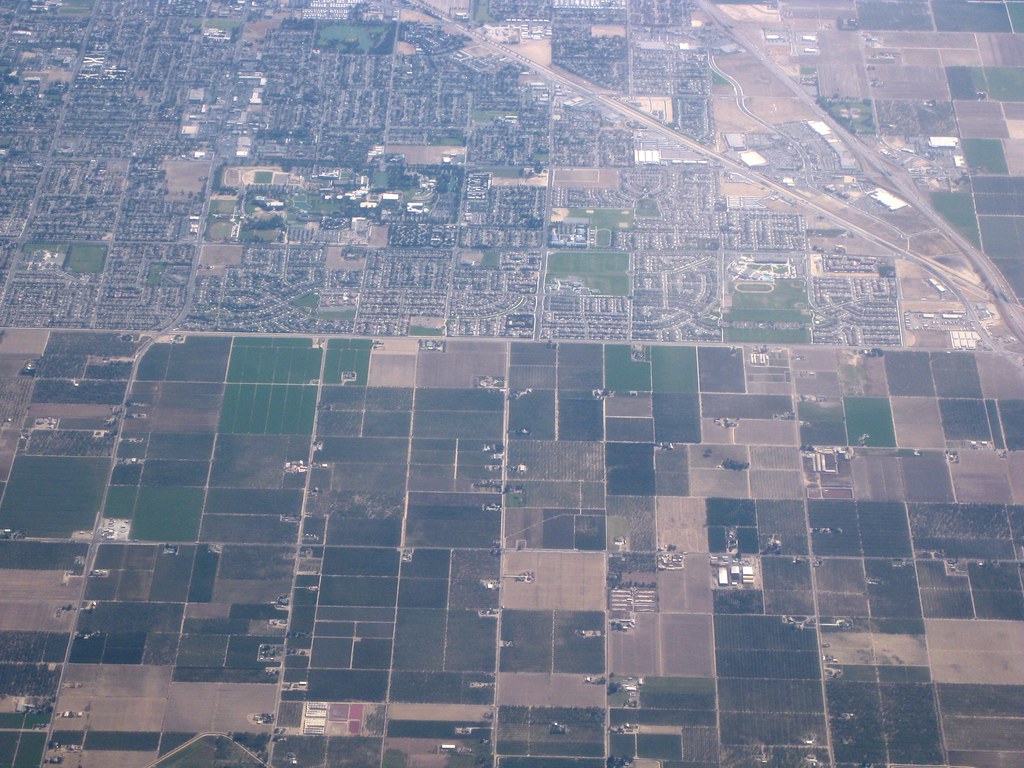
Professor Elizabeth Deakin was the fourth speaker. She described results of a study she had done for the California High Speed Rail Authority for several Central Valley cities on how they could use HSR to revitalize their city centers. Her presentation was fascinating because she was able to show how these cities could use infill to grow into much more sustainable places while maintaining local building styles and character. Her drawings and planning maps helped illustrate the great potential HSR has for creating livable and environmentally sustainable cities.
Professor Arpad Horvath talked about the full life cycle environmental impacts of HSR. His main point was that HSR needs to be well used to be a more sustainable form of transport than automobiles or airplanes. However, if well used, HSR would be good for the environment. Another important point was that much of the electricity generated for California has a high level of sulfur dioxide (SO2), which means that HSR would generate more SO2 than driving or flying (on a per passenger KM life cycle basis), therefore, as part of the California HSR project, the state needs to develop alternative sources of electrical energy (not a bad idea).
Professor Samer Madanat, Director of the ITS, summed up the main points and moderated the question and answer period. He emphasized the fact that most of the speakers emphasized the need for good feeder systems and improved land use planning to make HSR successful.
The seminar was an excellent overview of ideas for making high speed rail in California more successful. The ITS is trying to develop an organized center for continuing and expanding this interdisciplinary research, I hope that they are able to attract the funding and support necessary to create the center.
Sunday, September 13, 2009
David Bryne on Cities

I loved listening to the Talking Heads, it wasn't just the music, but that the lyrics were always (well almost always) so thought provoking. Last week, David Bryne wrote a wonderful essay on cities for the Wall Street Journal (of all places!?!?). The article David Byrnes's Perfect City is as clear and on target as his music. What a talented observer of cities and how they work. Thanks to Richard Florida and the Creative Class for the heads up. The photo above is of a sidewalk cafe in the Saint Gilles neighborhood of Brussels.
Wednesday, August 5, 2009
7 Freeways to Demolish - The Infrastructuralist

The Infrastructurist just published a column on seven freeways to demolish.
One of the freeways is Buffalo's Skyway. As a native of Buffalo I agree with Michael, who commented on the great views from the Skyway.
But ... why stop at tearing down the Skyway in Buffalo? Interstate 190 goes north from the Skyway cutting the city off from LaSalle Park and continues along the banks of the Niagara River ... what could be a magnificent riverfront. The lighthouse above is on the shore of Lake Erie at the Coast Guard station.
View Buffalo Freeways to Demolish in a larger map
Next up, Buffalo's Inner Beltway. Let's start with the Scajaquada Expressway (NY 198), running along Scajaquada Creek through the Fredrick Law Olmsted Delaware Park (!!!). Then the depressed freeway in the Olmsted-designed Humboldt Parkway (I guess it was OK to put a freeway through the parkway in the African American neighborhood but not the one in the mansion district: Chapin Parkway).
Yeah, yeah, "What will happen to the traffic?" "Buffalo needs the freeways for economic development."
Figuring out how to deal with the traffic would take some creative transportation planning, but maybe what Buffalo really needs is some bold thinking for the future.
You can collaborate on my Google map: http://maps.google.com/maps/ms?ie=UTF8&split=0&ei=wZN5SvbpKdDA-QaptqHMBQ&hl=en&msa=0&ll=42.947879,-78.906898&spn=0.163347,0.285988&z=12&msid=100003964992135061831.00047065a0fdb1357f905
Monday, June 22, 2009
Top 10 Demolished US Railway Stations
Great article on the Infrastructurist blog on the top 10 demolished train stations in the USA.
I particularly agree with the comment from Eric, now we should focus on an article listing the top 10 great train stations to save. He suggests Detroit and Buffalo.
I totally agree about Buffalo's Central Terminal having taken one of the last trains that stopped there on my way to college at Rensselaer Polytechnic Institute.
I particularly agree with the comment from Eric, now we should focus on an article listing the top 10 great train stations to save. He suggests Detroit and Buffalo.
I totally agree about Buffalo's Central Terminal having taken one of the last trains that stopped there on my way to college at Rensselaer Polytechnic Institute.
Wednesday, May 27, 2009
Car Free Times Square
Wow, talk about big successes. Yesterday Times Square in New York was made car free. Here's the story and nice photos: The Crossroads of the World Goes Car Free from Streetsblog. Most interesting to me is the fact that the idea came from a group of activists and went from dream to reality in less than five years ... amazingly fast for a project so significant.
Saturday, May 23, 2009
Congress for New Urbanism Video
Here's a great video by John Paget. It won a contest held by the Congress for New Urbanism (or as the film says AKA traditional urbanism) on the connection between urbanism and the environment.
Wednesday, May 20, 2009
Mathmatics of Urban Infrastructure
Steven Strogatz, a professor of mathematics at Cornell University, just blogged about Math and the City in the NY Times. The article is fascinating because he describes mathematical relationships that seem to hold for city size and infrastructure, and how these are similar to those for living organisms. For example, large animals have a smaller circulation system (per unit volume) than small ones, just like large cities have fewer roads (per person) than smaller cities:
The same pattern holds for other measures of infrastructure. Whether you measure miles of roadway or length of electrical cables, you find that all of these also decrease, per person, as city size increases. And all show an exponent between 0.7 and 0.9.
In other words larger cities are more efficient than smaller ones.
Tuesday, May 19, 2009
Carbon Taxes to Reduce Hot Air
Tim Harford, one of my favorite economists, just reviewed David J.C. MacKay's new book Sustainable Energy – Without the Hot Air. MacKay is a Cambridge physicist who analyzes the physics of various renewable energy sources to see how they can help reduce climate change. Short answer: No. But, read the book or Harford's article for the long answer.
Armed with a knowledge of the physics of renewable energy, it is clear as Harford points out:
Armed with a knowledge of the physics of renewable energy, it is clear as Harford points out:
Dealing with climate change will need many small decisions to be made differently. The government cannot micromanage these. This is why a carbon price, whether set through taxes or emissions permits, is needed. It is not so much a nudge as a shove in the right direction.
Wednesday, April 22, 2009
Future Urban Transport Conference - Days 2 and 3

Yesterday I discussed the academic workshop held at the Future Urban Transport Conference, today I discuss the second two days which were devoted to a wider discussion of issues.
 On Monday, we started with presentations from very high level business leaders at AB Volvo, Bombardier Transportation, Volvo Car Corporation and the Swedish Petroleum Institute. They described what their companies were doing in the areas of future urban transport. Next we heard from the Mayor of Goteborg, the Deputy Mayor of Changsha (China) and Kulveer Ranger (Director of Transport Policy for the Greater London Authority). They described how their cities were addressing the issue of sustainable transport and urban planning. The final session discussed 'service' business ideas: urban freight management, Veolia Transport (a major operator of public transport services) and a property developer from Stockholm who described how they redeveloped an old industrial area.
All the presentations were interesting, although I think that the discussion would have been better if the groups were mixed rather than in the "silo" based format. For example it would have been interesting to have the Bombardier's president discuss where and when rail investment is warranted with a policy maker from a developing country in Asia or Africa. Or having the Volvo Cars president discuss with London's transport policy director how to make electric cars a reality (London believes electric car technology is ready for deployment now, it would have been interesting to hear the auto industry's view on that).
On the other hand, the conference was small enough so that we could discuss many of these issues on a one-to-one basis. In fact, I discussed Shai Agassi's very interesting Better Place proposal for deploying electric cars NOW with London's Mr Ranger the evening before over a beer.
We started Tuesday with two videos of James Bond in Bremen. Then four focused discussions of specific research projects sponsored by the VREF. Professor Lisa Schweitzer (University of Southern California) talked about the need to proactively work on development around rail stations in disadvantaged areas. Professor Yves Crozet (University of Lyon) described how to improve accessibility for disadvantaged areas by focusing on slower modes of transport based on a case study of Lyon's BRT line (the case study used a very cool GIS analysis).
Next we heard from Professor Anthony May (University of Leeds) on the results of a quick analysis of transport financing in France, Germany, Great Britain and Japan. What was most surprising was the lack of detailed research in the area of comparing these systems and the high degree of variation. (This would be an excellent subject for my WIKI-based transport knowledge management system, more later.) Finally, Professor Elizabeth Deakin (UC Berkeley), another of my favorite UCB professors, talked about the US transport funding situation. Both presentations included several excellent recommendations for improving the funding process.
In the afternoon a small group of us visited the Volvo Museum and learned a bit more about the Volvo buses. More tomorrow.
Future Urban Transport Conference - Göteborg Sweden

I just returned from the 4th Future Urban Transport Conference held in Göteborg. The conference is sponsored by the City of Göteborg, the Volvo Research and Education Foundations and the Volvo company. (The photo above is of the design on the sides of Göteborg's public transport vehicles - they have a great PT system including a new bus rapid transit line.)
The conference was excellent, blending academic research with public policy and business issues. The first day consisted of presentations from academic researchers. Many were from programs sponsored by the VREF and there was a real diversity of ideas and opinions expressed. The conference website shows the schedule with links to the presentations.
One of the most interesting presentations for me was the keynote by Professor Geetam Tiwari who discussed some of the research done at her institute in New Delhi. Her presentation Public Transport Use - Emerging Issues really made you think about some preconceived ideas about public transport (is a new metro the right solution for cities like Delhi? is public transport really safer than alternatives? what are the real equity issues in transport?).
I also really enjoyed Professor Carlos Daganzo's presentation on A Cheap and Resilient Approach to Eliminating Bus Bunching. Professor Daganzo was one of my teachers at Berkeley and he always amazed me by being able to translate very complex mathematical analysis into practical ideas, and even better, to make them easily understandable. As a public transport rider I feel like I am affected by bus bunching every day and so I hope to work with Vienna Transport to test Carlos' idea on my local bus line. I'll keep you updated.
The third presentation that made a big impact on me was by Professor Harry Dimitriou: Mega transport Projects, Globalization and Private Finance: Emerging Challenges for the 21st Century. The topics he raised are especially topical since many policy makers have been operating under the assumption that private finance (e.g. public private partnerships etc.) are the answer to solving our transport infrastructure problems ... but the private finance model seems to have let us down in the last several years, what does this mean? Among the interesting points he made is that the private sector is not necessarily more efficient than the public sector, that finance companies and government can have very different objectives for their assets (financiers may want to churn the asset to generate short term profits, government wants an efficient and sustainable infrastructure solution), etc. Fascinating ideas extremely relevant for today's problems.
I could go on since there were many other interesting papers and discussions. Tomorrow more on the second two days of the conference.
Tuesday, April 14, 2009
Saving the Auto Industry - Jon Stewart
| The Daily Show With Jon Stewart | M - Th 11p / 10c | |||
| You're Welcome - Auto Industry | ||||
| ||||
John Hodgman, The Daily Show with Jon Stewart's "You're Welcome" correspondent presents his ideas for saving the auto industry. I really miss the Comedy Channel!
Thursday, April 9, 2009
Burnham Plan for Chicago
2009 is the centenial of Daniel Burnham's plan for Chicago. We studied this plan in all my history of city planning courses, not only the content, which was quite advanced, but the beautiful drawings and associated public relations efforts (they even created a textbook for school children to teach them about the importanace of good city planning and implementing the plan). To celebrate the centenial the Chicago Public Library has created a website: The Burnham Plan Centenial with lots of good information.
Thursday, April 2, 2009
Rebuilding Cities: Buffalo NY

Nicolai Ouroussoff had a great article in Sunday's NY Times: Reinventing America's Cities: The Time Is Now. The article outlines the need for coordinated planning and, can I say: "big" ideas for making US cities more attractive and livable.
He discusses specific plans for New Orleans, Los Angeles, the Bronx and my hometown Buffalo, as well as more general concepts that would help. I was particularly interested in his description of Buffalo, especially the problematic plan by the US Department of Homeland Security to greatly expand the Peace Bridge Customs area. Ouroussoff mentions that preservationists in Buffalo are fighting the plan, I wish them good luck!
 Buffalo could be a poster child for the problems with urban redevelopment projects. Ouroussoff mentions that an aerial freeway was built through one of Fredrick Law Olmsted Sr's parks ... actually it's worse, another two freeways were built: a surface freeway through Olmsted's Delaware Park and a depressed freeway through Olmsted's Humboldt Parkway (which also happened to be an African American neighborhood). The city's light rail system was build mostly underground thus reducing the possibility for community development similar to Portland Oregon around its surface LRT line (not to mention drastically increasing construction and operating costs).
A real problem hindering big planning ideas is that cities like Buffalo need to think small. In other words how to best grow into smaller cities. That goes against the traditional political and business "boosterism" but it's reality. And, smaller could really be beautiful.
Why not simply tear down the freeways - there's less traffic? Replace them with surface boulevards like San Francisco or Milwaukee or re-route the traffic. Rebuild the parks they run through: daylight the Scajaquada Creek from Delaware Park to the Niagara River.
 Why not use the existing International Railway Bridge to create a "moving inspection" system for homeland security. Trucks would be loaded on railcars and be inspected on a continuous system of automatic sensors located along the railway track. Not only would such a system eliminate the need for increasing the Peace Bridge inspection facilities, but it would reduce emissions and increase the efficiency of freight transport (less waiting at inspection). Such a system could be a model for other border crossings. In the long term it could increase the amount of freight shipped by rail.
Why not develop a program to focus redevelopment in certain neighborhoods and create a 21st Century equivalent for Olmsted's park system? Such a plan would reduce infrastructure costs and help create the kind of environment that could attract new residents and businesses to Buffalo. The parks could even offer 'economic crisis victory' gardens to nearby residents.
Why not preserve the grain elevators and Buffalo River area as an urban park the way many Ruhr District cities have done. But, the list of ideas is endless.
This kind of planning calls for creativity - which is clearly available - and government programs like those called for in Ouroussoff's article. Let's hope that the Obama Administration doesn't stop thinking about tomorrow.
 Ouroussoff mentions that Europe looked to the USA in the past for planning ideas and now the US is looking at Europe. But there is an Architect Engineer from 1890s Vienna, Otto Wagner, that also provides a clue. He planned Vienna's urban transport system combining existing rail lines with new lines and building stations, bridges and facilities that, while serving engineering functions very well, are also beautiful. He did the same with flood facilities. I think there's a lot to learn from his work as well. The photos with the posting are from my flickr photos Vienna Public Transport Otto Wagner.
Thursday, March 19, 2009
Pogue on Electric Cars - It's the system not the car!
The NY Times' David Pogue has a great blog post about a group of people developing a 'system' for making electric cars happen. The basic idea is that they rent you the batteries for your electric car. He titled his posting Electric Cars for All! (No, Really This Time) that about covers it don't you think?
Richard Florida on Bailouts and Stimulus
Richard Florida, one of my favorite 'planner economists' has been writing about the bailouts and stimulus plans on his blog in the last couple days. It's particularly good because he addresses several of the questions that always seem to come up regarding his work "everyone can't be in the creative class, what about the others?" etc.
I am especially concerned that we are wasting a great opportunity to create a more future-oriented economy. We should be using the stimulus to move towards a more environmentally and economically sustainable future. Of course, if we don't someone else is likely to do so, as Florida puts it:
I am especially concerned that we are wasting a great opportunity to create a more future-oriented economy. We should be using the stimulus to move towards a more environmentally and economically sustainable future. Of course, if we don't someone else is likely to do so, as Florida puts it:
The clock of history ticks on. Over time, it tends to leave behind those places who get stuck, get trapped, or try too hard to breathe life back into the old order, neglecting the new one that is emerging. And that’s what really worries me.
Friday, February 27, 2009
More Amsterdam, less suburban-dam!

Amsterdam street scene, March 2008
David Brooks, a syndicated columnist from the NY Times, had a column this week titled "I dream of Denver" basically saying that most Americans did not want to live in Amsterdam (i.e. "dense" older cities). Paul Sighley, who writes a blog for the California Planning and Development Report, took issue with Brooks, and believes that the poll upon which Brooks based his column really shows that Americans want options beyond suburban sprawl. He says,
It makes me wonder if we have built enough suburbia to last us for another a generation or two. Maybe, just maybe, we in California should be focused on making cities – whether they be like San Jose or Anaheim – better places to live. Maybe we should make our small towns – whether it’s Chowchilla or Ukiah – complete places to live, learn, work and recreate. And maybe we should pause before we convert our rural places – whether it’s the Salinas Valley or the Sierra foothills – into suburbs.
Most planners are not advocating for an American Amsterdam, and neither am I. I’m only pointing out that not everyone – nowhere near a majority, according to Pew – wants to live in Roseville.

As a former Californian who has moved to one of those old European cities, I can only say I really enjoy the urban lifestyle and hope that California can develop more real urban areas like San Francisco and Los Angeles. Maybe the economic crisis maybe will give us the opportunity to "reset" into a more sustainable and exciting built environment.
Saturday, February 21, 2009
Bread Delivery
My friend Walt, living in France, describes a dilemma he is facing ... how much bread to buy from the delivery service. I can relate because these kinds of services are really wonderful.
In the Austrian countryside many people still bake the traditional sourdough bread in large wooden ovens (sometimes located in the yard). It's a big effort, and since the bread stays "fresh" for about two weeks, they usually bake enough for friends too. They deliver the bread or people pick it up, it's a nice chance for socializing.
I put "fresh" in quotes because the bread is very dense (like Pumpernickle in the USA). Also, it's not sour like San Francisco sourdough bread, just a little sour. But, it's really tasty. Interesting too that almost everyone has one of those slicing machines that are used to cut cold cuts in a delicatessen and uses it to cut the bread (aboout 1/4 inch thick) - it's almost too hard to cut with a knife.
Regarding the delivery, I wonder if there is not some way to make the system more efficient and thereby ensure its survival? Maybe delivering more than just bread (Walt's baker also delivers cheese) or serving several customers at one stop (customers would walk to the gathering point).
My questions are more than just general interest, I am working on an interesting research project that is trying to find ways to better meet the transport needs of changing demographics; and as people get older these types of delivery systems will become more important, especially in rural areas.
In the Austrian countryside many people still bake the traditional sourdough bread in large wooden ovens (sometimes located in the yard). It's a big effort, and since the bread stays "fresh" for about two weeks, they usually bake enough for friends too. They deliver the bread or people pick it up, it's a nice chance for socializing.
I put "fresh" in quotes because the bread is very dense (like Pumpernickle in the USA). Also, it's not sour like San Francisco sourdough bread, just a little sour. But, it's really tasty. Interesting too that almost everyone has one of those slicing machines that are used to cut cold cuts in a delicatessen and uses it to cut the bread (aboout 1/4 inch thick) - it's almost too hard to cut with a knife.
Regarding the delivery, I wonder if there is not some way to make the system more efficient and thereby ensure its survival? Maybe delivering more than just bread (Walt's baker also delivers cheese) or serving several customers at one stop (customers would walk to the gathering point).
My questions are more than just general interest, I am working on an interesting research project that is trying to find ways to better meet the transport needs of changing demographics; and as people get older these types of delivery systems will become more important, especially in rural areas.
Subscribe to:
Posts (Atom)