Pages

Showing posts with label Railway photos. Show all posts

Sunday, January 15, 2012

Steam Train Wedding - Music Video

Swiss Steam Train Wedding 7

As we were driving by a railway station in the Berner Oberland (Switzerland) we saw a steam engine being prepared for a trip. I screamed that we had to stop and go back. We got to the station in time to see a wedding party boarding the steam train for an excursion.

I just had to write a song about the experience. It's on YouTube: Steam Train Wedding.


Tuesday, April 5, 2011

Vacations without cars!


One of my favorite places in the world, Scuol Switzerland. You don't need a car as this photo shows ... it says: Engadin Scuol - for vacations without cars!

More photos of the Scuol Railway station, a wooden bridge and the great food we ate on my flickr set: Scuol Switzerland.

Saturday, May 22, 2010

International Conference Calls


Telephone booths in Basel railway station (Switzerland) from my flickr photos.

GigaOM's Web Worker Daily has a nice article summarizing tips and best practices for international telephone conference calls. These would have helped me in numerous cases!

Wednesday, March 24, 2010

Builder Bob on Westbahnstrasse


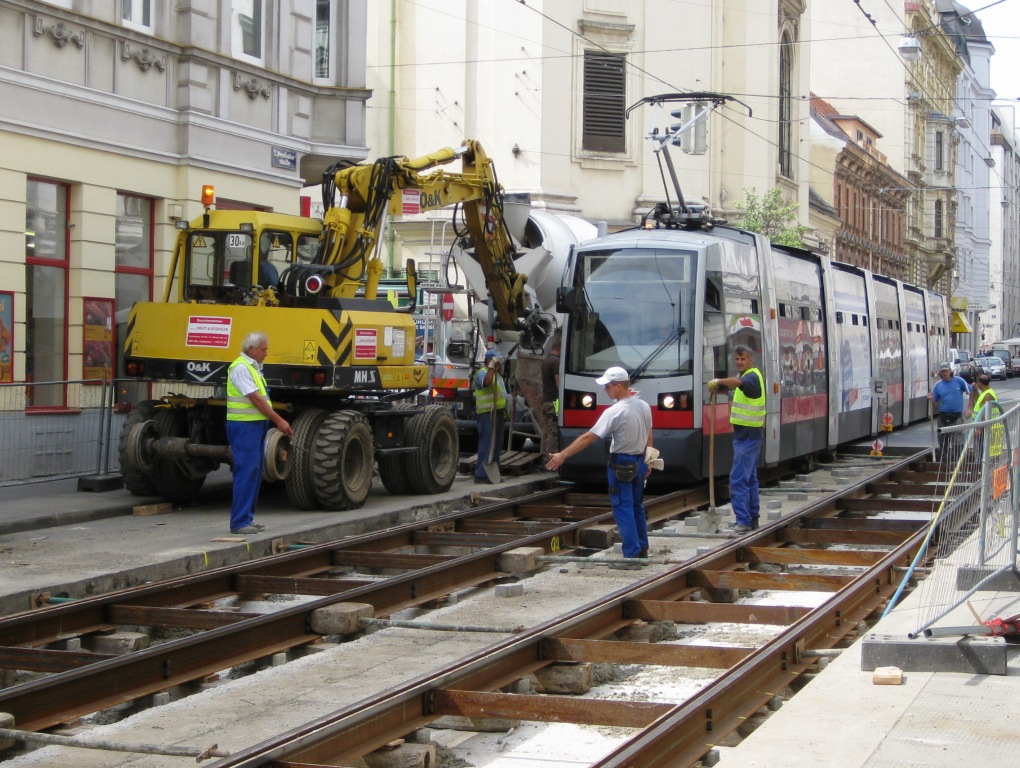
I just finished my series of website pages describing the Westbahnstrasse Tram Track Rehabilitation Project completed during the summer of 2009. The two new pages present aerial views of the work (from a neighbor who was also fascinated by the construction process) and photos of the workshop where the Wiener Linien prefabricate the track by cutting, bending and welding together sections of rail. The website pages include photos, descriptions and YouTube video links.

Now I can get started on this summer's Westbahnstrasse project: the Westbahnstrasse Chronicles! Stay tuned.

Monday, September 7, 2009

Westbahnstrasse Tram Track Reconstruction


As I mentioned in previous posts the Wiener Linien has been rebuilding the tram tracks in our neighborhood this past month. I am putting lots of the photos on my website and also several movies. I now have five movies of the construction process on YouTube, above is one of them. I will write another post when the website is finished.

Wednesday, September 2, 2009

Otto Wagner and Vienna Transport - 1


A colleague from San Francisco was in town last week and, as usual, visitors call attention to the things you don't always notice as you go about your everyday business. I have been following his blog (Jarrett Walker, www.humantransit.org) and added a couple comments and then thought, well one of these comments is something I've wanted to write about myself for a while, so here's a first installment on Otto Wagner and his influence on Vienna transportation planning.


Otto Wagner is a fascinating example of an architect who also did some great urban civil engineering. There is a nice exhibition of his work at the Wien Museum's Otto Wagner Pavilion located in the Karlsplatz U-Bahn entrance (designed by Wagner). The museum is very small but manages to present a good summary of Wagner's work.

Also don't miss his Hof Pavilion
(German website, nice photos) a private station designed for the Kaiser at Schönbrunn (the Kaiser's summer palace). The Hof Pavilion is adjacent to the Hietzing U-4 station (one station beyond the Schönbrunn station). Right now it's only open on Sunday mornings (see German website for times) but well worth the visit for fans.

Of course you can still see Wagner's influence in the design of many stations on the U-4 and U-6 lines. Both these lines were operated with steam engines in Wagner's day (he developed the conceptual plan for these lines as well as designing many of the stations and infrastructure). The photo on the right is of his famous bridge on the U-6 line over the Vienna River at the Gürtel. The photo is taken from the U-4/U-6 Längenfeldgasse Station.


Wagner's lines were later converted to electric trains then into Vienna's U-Bahn network, but many stations were maintained and have been renovated. The photo on the right is a detail of Wagner's bridge on the U-6 line. All photos are on my flickr photos of Vienna public transport, where there are many more photos of Otto Wagner stations and bridges.

Vienna has done a wonderful job restoring many stations designed by Wagner. A couple years ago they rehabilitated the Gumpendorferstrasse Station (U-6) - shown at the top of this post. They did a great job integrating new features (e.g. elevator) and new floor tiling (rubber non slip) that matched the old style. It is great that Vienna does not eliminate history from their transportation infrastructure in the name of efficiency or current fashion. As places like NY Grand Central Terminal show, old pedestrian flow designs often work much better and the buildings are much more gratifying as many modern designs.

Monday, August 31, 2009

Westbahnstrasse Tram Track Reconstruction Pages

I've been working on my website pages that illustrate the reconstruction of the tram tracks on Westbahnstrasse (Vienna) near our house. The project is almost over and has been fascinating to watch.

Here's my Westbahnstrasse Tram Track Reconstruction Homepage with links to my pages on Construction signs and artistic photos.

Let me know what you think!

Thursday, July 30, 2009

Swiss Travel System Video Contest!


Here's my entry in the Swiss Travel System's video casting contest. Please take a look and rate the video highly ... extra points for those who know what I am alluding to ... send me a comment! Thanks, Andy

Saturday, July 4, 2009

Museum Tauernbahn: Austrian Railway Museum


A couple weeks ago we visited the Museum Tauernbahn Salzburger Eisenbahnmuseum (the Tauern Valley Railway Museum). The museum presents the history of the railway line that connected Salzburg with routes to Trieste (the main port city for the Austrian-Hungarian empire.

The museum is small but quite nice. You can reach it by taking the train from Salzburg to Schwarzach St. Veit - about one-hour trip. The museum is a few steps away from the station. If you come by train they give you a discount (3 Euros instead of 4-5 Euros).

The museum focuses on building the rail line through the alps. It has an old tunnel drilling machine, describes the construction process, the history of selecting the alignment and has a model of one of the worker bedrooms. Outside you can climb on an old locomotive and there is an old maintenance hall with exhibits on the signaling/interlock technology, power distribution and a model "station". Upstairs is a model railway (currently being completed) of the rail line.

The museum is open from May to early October Wednesday, Saturday and Sunday (and some Thursday nights) - check the internet site for details. The descriptions are in German, but the people are very helpful and many of the exhibits are self explanatory.

Here are my flickr photos of Tauernbahn Eisenbahn Museum.

Wednesday, July 1, 2009

Model Trains Anyone?

Wired is having a new contest for people to upload photos of their model trains. We don't have a model train at home, but maybe you do? Here's the link to WIRED Model Trains.

Monday, June 22, 2009

Top 10 Demolished US Railway Stations

Great article on the Infrastructurist blog on the top 10 demolished train stations in the USA.

I particularly agree with the comment from Eric, now we should focus on an article listing the top 10 great train stations to save. He suggests Detroit and Buffalo.
I totally agree about Buffalo's Central Terminal having taken one of the last trains that stopped there on my way to college at Rensselaer Polytechnic Institute.

Thursday, April 2, 2009

Rebuilding Cities: Buffalo NY


Nicolai Ouroussoff had a great article in Sunday's NY Times: Reinventing America's Cities: The Time Is Now. The article outlines the need for coordinated planning and, can I say: "big" ideas for making US cities more attractive and livable.

He discusses specific plans for New Orleans, Los Angeles, the Bronx and my hometown Buffalo, as well as more general concepts that would help. I was particularly interested in his description of Buffalo, especially the problematic plan by the US Department of Homeland Security to greatly expand the Peace Bridge Customs area. Ouroussoff mentions that preservationists in Buffalo are fighting the plan, I wish them good luck!

Buffalo could be a poster child for the problems with urban redevelopment projects. Ouroussoff mentions that an aerial freeway was built through one of Fredrick Law Olmsted Sr's parks ... actually it's worse, another two freeways were built: a surface freeway through Olmsted's Delaware Park and a depressed freeway through Olmsted's Humboldt Parkway (which also happened to be an African American neighborhood). The city's light rail system was build mostly underground thus reducing the possibility for community development similar to Portland Oregon around its surface LRT line (not to mention drastically increasing construction and operating costs).

A real problem hindering big planning ideas is that cities like Buffalo need to think small. In other words how to best grow into smaller cities. That goes against the traditional political and business "boosterism" but it's reality. And, smaller could really be beautiful.

Why not simply tear down the freeways - there's less traffic? Replace them with surface boulevards like San Francisco or Milwaukee or re-route the traffic. Rebuild the parks they run through: daylight the Scajaquada Creek from Delaware Park to the Niagara River.

Why not use the existing International Railway Bridge to create a "moving inspection" system for homeland security. Trucks would be loaded on railcars and be inspected on a continuous system of automatic sensors located along the railway track. Not only would such a system eliminate the need for increasing the Peace Bridge inspection facilities, but it would reduce emissions and increase the efficiency of freight transport (less waiting at inspection). Such a system could be a model for other border crossings. In the long term it could increase the amount of freight shipped by rail.

Why not develop a program to focus redevelopment in certain neighborhoods and create a 21st Century equivalent for Olmsted's park system? Such a plan would reduce infrastructure costs and help create the kind of environment that could attract new residents and businesses to Buffalo. The parks could even offer 'economic crisis victory' gardens to nearby residents.

Why not preserve the grain elevators and Buffalo River area as an urban park the way many Ruhr District cities have done. But, the list of ideas is endless.

This kind of planning calls for creativity - which is clearly available - and government programs like those called for in Ouroussoff's article. Let's hope that the Obama Administration doesn't stop thinking about tomorrow.

Ouroussoff mentions that Europe looked to the USA in the past for planning ideas and now the US is looking at Europe. But there is an Architect Engineer from 1890s Vienna, Otto Wagner, that also provides a clue. He planned Vienna's urban transport system combining existing rail lines with new lines and building stations, bridges and facilities that, while serving engineering functions very well, are also beautiful. He did the same with flood facilities. I think there's a lot to learn from his work as well. The photos with the posting are from my flickr photos Vienna Public Transport Otto Wagner.


Wednesday, November 19, 2008

Buffalo NY Architecture

There was a very nice article on historic architecture in Buffalo in last Sunday's NY Times. Saving Buffalo's Untold Beauty by Nicolai Ouroussoff described some of the architecture I grew up around and which had a real influence on my life. Omstead's parkways in particular helped show me how to integrate beauty and livability into transport projects.

Another great Buffalo website is: Welcome to Forgotten Buffalo ... they have tours and information on architecture and life in the Queen City of the Great Lakes.

Friday, October 31, 2008

Antwerp Main Railway Station

One of my photos of the Antwerp main railway station was selected for the Schmap guide to Antwerp. I love the photo because it's one of those railway wheels with wings sprouting from the axle. In this case it's all golden.