Pages

Showing posts with label architecture. Show all posts

Sunday, June 27, 2010

Prague Arcades

Lucerna Arcade Prague

I've always been fascinated by arcades, those ‘shopping mall precursors’ in cities where a set of shops runs in a corridor through the middle of a building. Paris and Brussels have a couple of great old ones, I even like the modern Funf Hofe in Munich, but for some reason I never noticed Prague’s arcades on previous trips. This week, while walking around aimlessly looking for a good place to eat (one of my favorite activities), I found myself in a really cool one, the Lucerna, which made me notice many more.

Adria Arcade Prague

Like most of Prague all the arcades I visited are showing their age. Most of the shops, restaurants and cafes located in them are not flashy or the latest trends (in contrast to Munich!) but seem to cater to the normal needs of locals.


The Lucerna, like many of the arcades, was actually a series of arcades connected together so they differed stylistically and in terms of tenants and state of repair. Only one of the arcades is actually the Lucerna, the others were called Rokoko and Dum u Novaku (sorry for not using the Czech spelling, no keyboard). These were particularly interesting since the connected arcades were in very different styles.
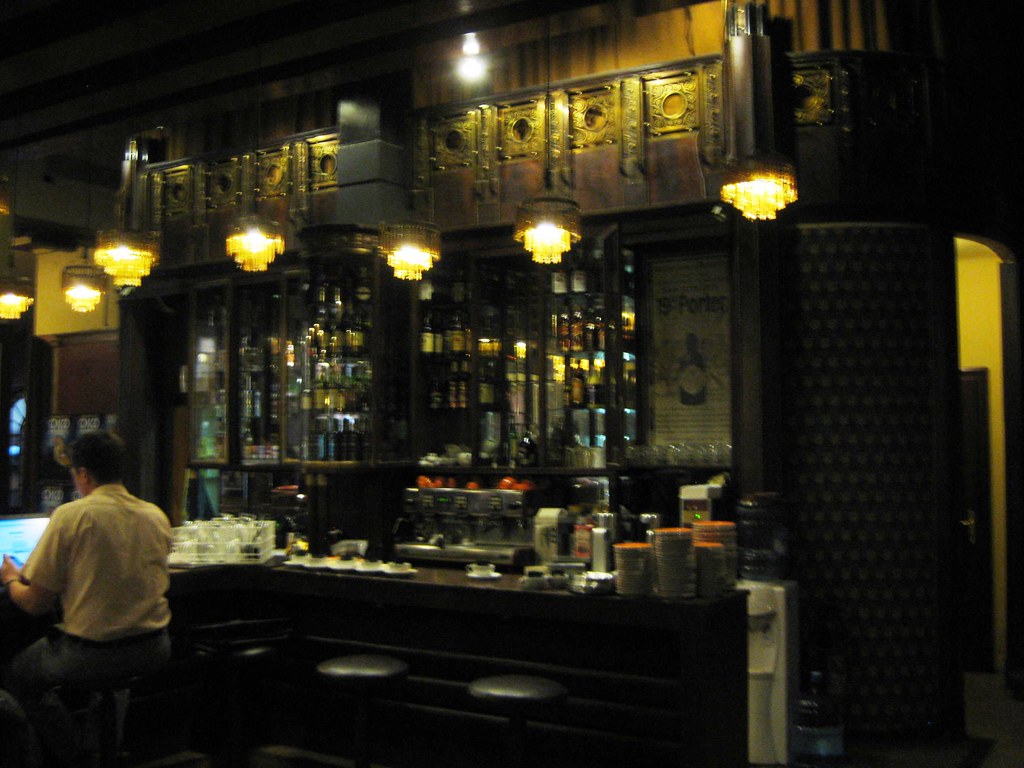

Kino Cafe in Lucerna Arcade, Prague

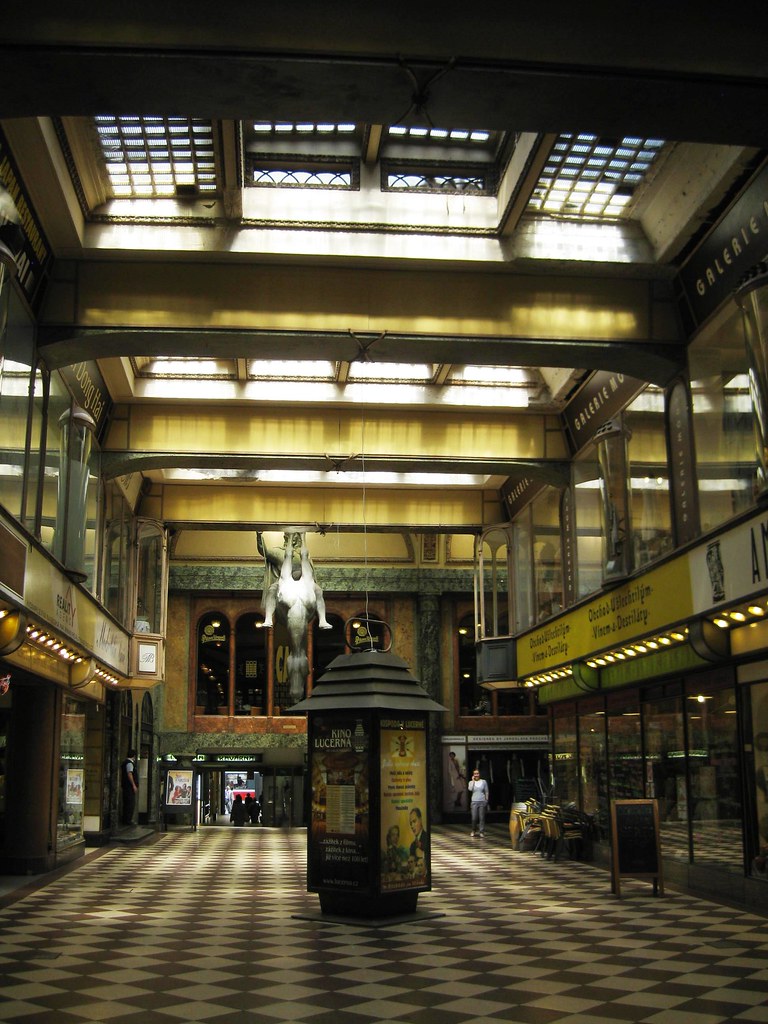
The Lucerna arcade is built around a movie theater with several places to eat and a music/beer club. The architecture features lots of marble and a huge hanging sculpture of a knight riding a horse, but the horse is upside down (feet up) and the knight is riding on the horse’s stomach (see top photo). I had a coffee in the coffeehouse with windows over looking the sculpture. The coffeehouse was great, it was clear that it was used for performances (there was a grand piano), there were some children playing in a corner with the parents having a coffee and chat. The cafe probably gets lots of visitors after shows.
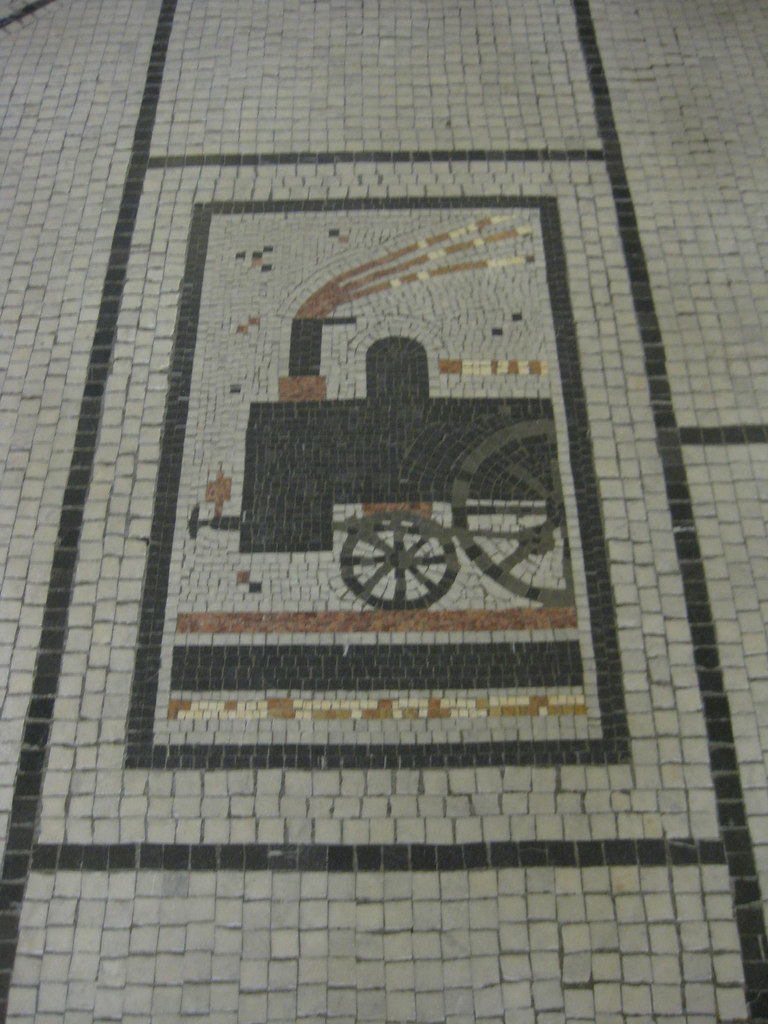
The Adria arcade was located on Jungmannova Street near my hotel. There I was most impressed with the old art deco architecture and decorations. The mosaic caught my eye with two railway scenes. There was a very nice old sign for a record producer around the doorway of a former tenant. As I left I noticed that the building seemed to have originally been built for one of those old transport insurance agencies (there was a sculpture with a powerful figure seeming to protect a ship in heavy seas).
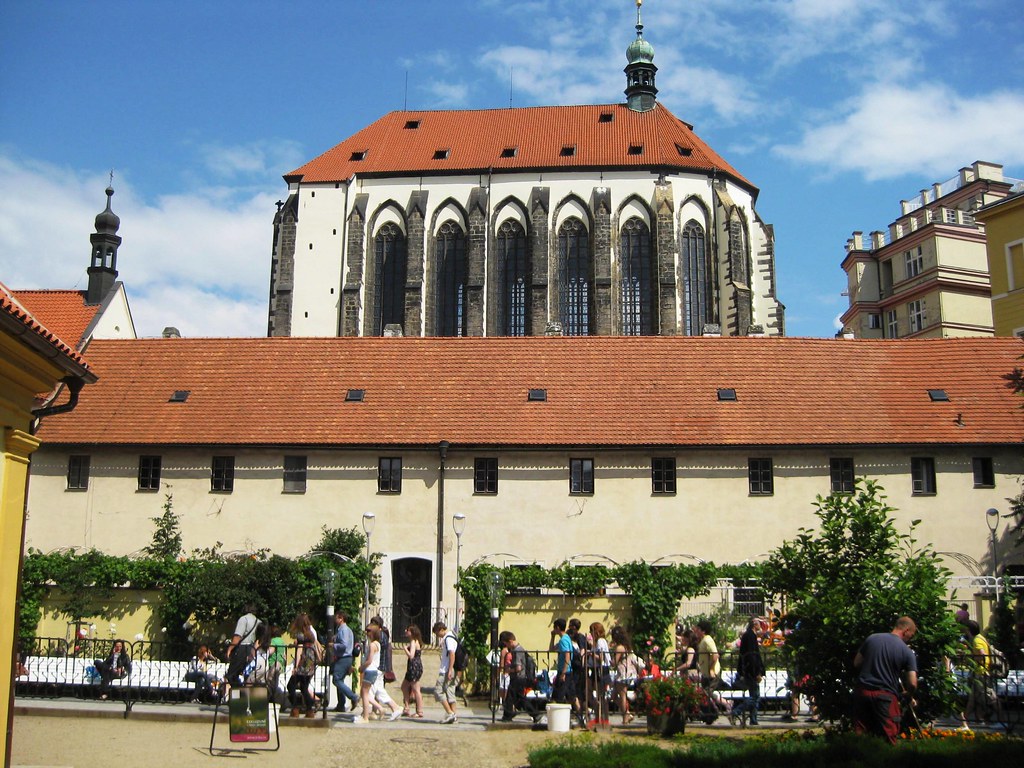


Not really an arcade, but opening on to one, was the Franciscan Cloister garden. This is a truly beautiful urban open space. Located in the middle of a block, it’s a quiet oasis (except for the sound of children playing) in the center of the city. It’s well maintained with beautiful flowers and lots of benches (many of which are full). There’s a great fountain sculpture of a naked child playing with water … the children around all loved it.
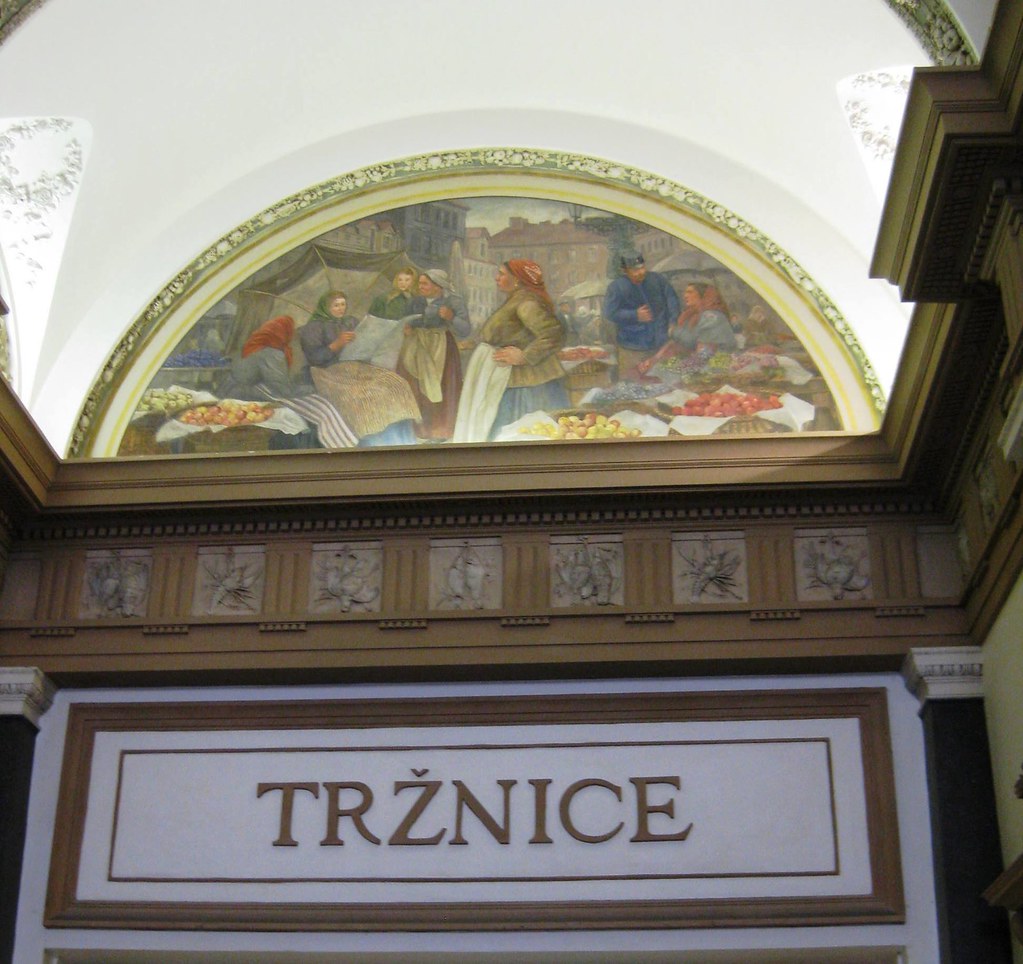


Finally, I discovered the Trznice arcade on Rytirska Street. I was drawn in by a beautiful painting of a market scene over the interior doorway (photo). As I walked though I found that the arcade had been remodeled with a grocery store, drug store and a couple other 1980s style shops. The space itself had been given one of those dropped ceilings (it was still quite high) but there was a skylight through which you could see the original metal and glass roof (photo). It’s too bad there is not enough money to rehabilitate all these beautiful structures.

All my Prague arcade photos are here.

Friday, June 18, 2010

A little more to the left please!

Here's a photo from my recent visit to Trieste. On the Piazza Italia, it looks like the main figure in this statue is directing the crane operator. Well, a little bit. My Trieste flickr photos.

Tuesday, June 1, 2010

Rivets are not just for frogs!

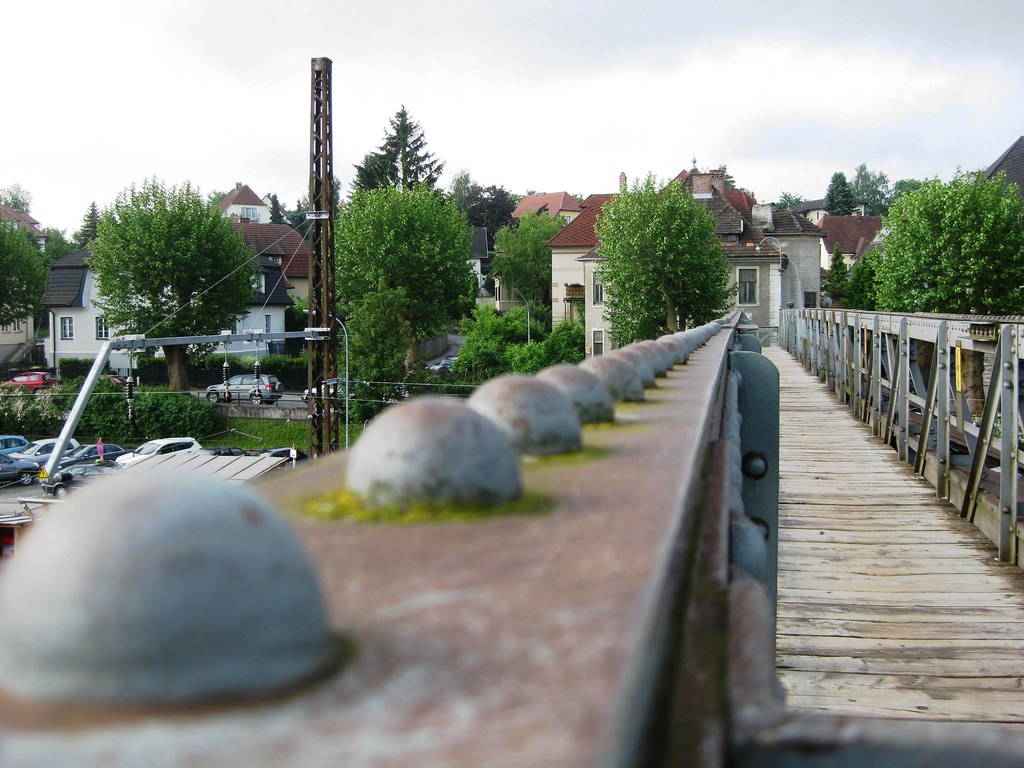
One of my civil engineering professors at RPI used to always talk about the 'built up' columns in the New York City subway stations. The "I" beam shape is very strong and efficient, but it was impossible to make "I" beams directly before the 1908 when a man named Henry Grey invented a mill machine that could roll the shape. So steel workers needed to build their own "I" beams in the field by joining steel plates with rivets. I was reminded of my civil engineering studies when I visited Melk last week and used the pedestrian bridge to cross the tracks.

By the way, Grey worked for Bethlehem Steel, my first employer after graduating from RPI. I actually worked in one of the original "Grey" mill facilities in Bethlehem.

Thursday, May 27, 2010

Melk Monastery Austria

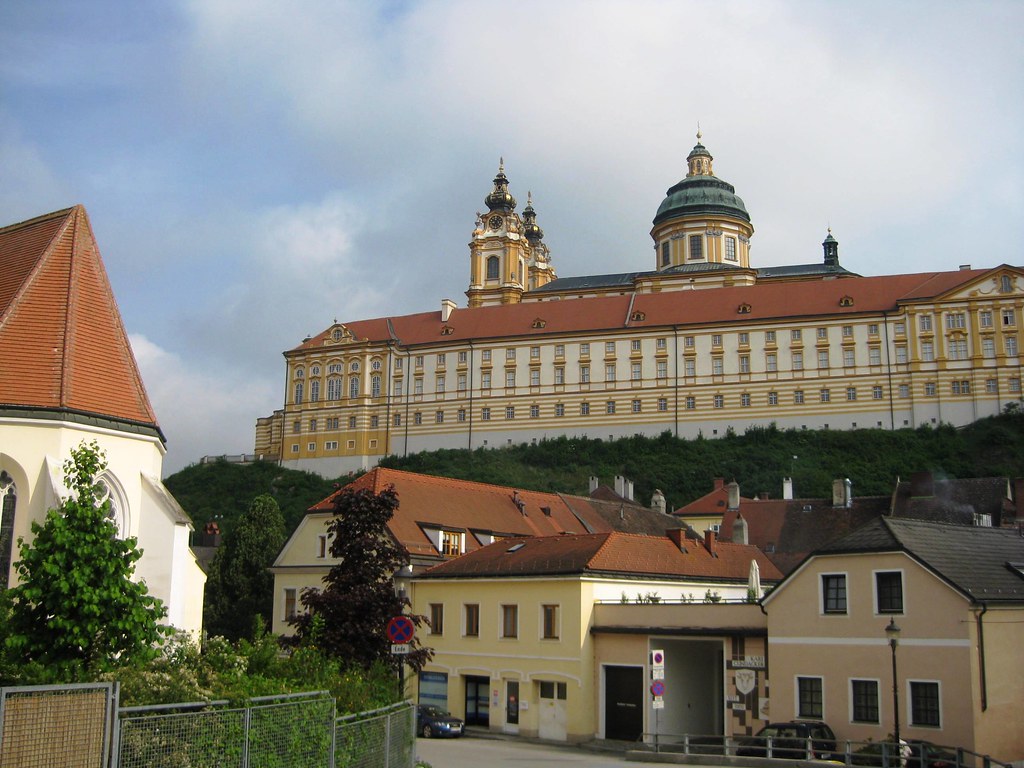
The Benedictine Monastery in Melk is a UNESCO World Heritage site about 90-km from Vienna so I wonder what has taken me so long to get there. All photos are from my flickr set Melk Monastery (lots more photos there!).


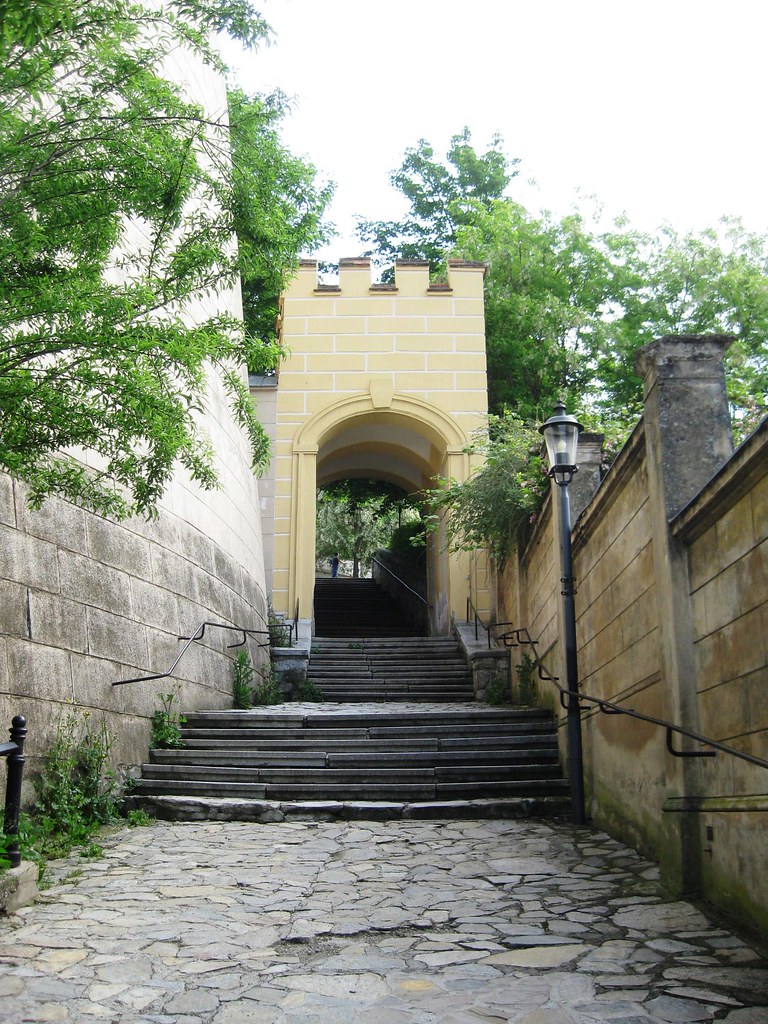
I took the train and got there at 9 am. It was an easy walk from the train station through a pedestrian district where a farmers market was just being set-up. There is a stairway from the pedestrian street which leads up the hill to the Monastery gate. You buy your tickets at the second courtyard; my ticket was for an English tour at 10:55, so I had some time. (The ticket cost 9.50 Euros.)

I went into the museum where the guard marked my ticket so that I could go in again with my scheduled tour. Even at this early hour there were many groups of visitors from Danube river tour cruise ships (Melk is located on the Danube and is a popular stopping point for river cruises). By staying in between the tour groups I had the museum rooms to myself for a few minutes. It's a very interesting exhibit of the Monastery history combined with the history of the Dominican order of monks.

At the end of the museum is the marble hall which has a beautiful trompe de oeil painting of main characters from Greek mythology on the ceiling (most of the marble is painted stucco, by the way). Leaving the marble hall you walk out on a curved walkway overlooking the church on the one side and the Danube river valley on the other.

The walkway leads to the Monastery library, a treasure house of old books and ideas. Only two of the rooms are open to the tourist public, but the other rooms are accessible to scholars. A flight of circular stairs takes you down to the ground level and the entry to the church.

The Melk Monastery is famous because the whole complex was built at the beginning of the 1700s, and is all in the Baroque style. The church is where the Baroque really lets loose. It's almost impossible to do justice to the space with a photograph. My early visit was quite nice because I was almost alone in the church (at 11:45 the church was almost full with tourists).

After leaving the church I visited the Monastery garden with its very nice garden lodge - cool frescoes - and took a walk down the garden path overlooking the Danube. Then it was time for my tour. The tour guide was excellent, he spoke very good English and knew his stuff.

After the tour I was hungry and had a nice lunch of Schweinsbraten and beer at the Monastery restaurant located just outside the main monastery buildings on the way to the parking area. The food was quite good and the service was very good (fast, friendly and efficient). My lunch cost 14 Euros.

Tuesday, May 25, 2010

Buffalo Architecture: H.H. Richardson's Buffalo State Hospital


H.H. Richardson: Buffalo State Hospital main building from my flickr photos.

On my recent trip to Buffalo I visited the Buffalo State Hospital grounds in an early, jet-lag induced, walk. Some of my photos are on my Buffalo flickr set tagged with H.H. Richardson: Buffalo State Hospital.

As I grew up the imposing main building (in the photo above) seemed always to be in view. We lived nearby and went to elementary school on the campus of the adjoining state college. It's a fantastic building, unfortunately it really seems to need repair.

Francis R. Kowsky, a Buffalo architectural historian, wrote a nice description of the complex and its history in 2000, it is reprinted on the web page Buffalo as an Architectural Museum:  A Towering Masterpiece: H.H. Richardson's Buffalo State Hospital.