Pages

Showing posts with label Railway Planning and Operations. Show all posts

Thursday, February 10, 2011

Graz Austria Main Train Station

Graz AT Hauptbahnhof  - 4

Since my wife is from Wolfsberg Austria (Carinthia) we travel frequently through the Graz Hauptbahnhof on our way south. There are hourly trains from Vienna to Graz, but then the fun begins.

There is no train service between Graz and Wolfsberg, but there is an "Intercity Bus" which is not bad, about an hour nonstop between the cities operated approximately every two hours. Unfortunately the bus and the train schedules are almost perfectly uncoordinated.

The bus from Wolfsberg (and Klagenfurt) is scheduled to arrive one or two minutes after the train to Vienna leaves. So you need to hang around in Graz Hauptbahnhof for about an hour. In the other direction many of the buses also require a long wait (Friday we waited 57 minutes, since the bus leaves 3 minutes before the next train from Vienna arrives).

Graz AT Hauptbahnhof  - 2

Perhaps the reason for this sloppy scheduling is that the buses used to leave a few minutes after the train from Vienna arrived. If the train from Vienna was at all late you missed your connection - then it's almost two-hour wait until the next bus. The new system allows the train to be almost an hour late and you can still make the bus.

Another problem with the bus is that it is frequently overbooked at peak travel times like Friday and Sunday evenings. We were lucky last Friday and they put another bus into service, but we have also been forced to drive to Graz because the bus is full.

Graz AT Hauptbahnhof  - 3
You may think - like the sign at the right says - "Missed your train? Great, you can have a coffee at the station" - but I don't know many people who think "Great" about missing their train. Yes, it is great that the station has restaurants and shops, but my goal is to get somewhere not to spend time in the station.

Oh, and one more thing as long as I'm ranting. You need to pay to go to the restroom in Graz! Why can't railway stations - especially railway stations with shopping centres - have free restrooms? I can't think of an automobile-based shopping centre that has restrooms where you need to pay. I understand that railway stations seem to attract people with social problems, but deal with the problems, don't make everyone pay. (Especially if you have restaurants serving coffee and beer!) By the way, the problem is not unique to Graz, they also charge for the restrooms in Vienna and Zurich.

Graz AT Hauptbahnhof  - 1

This kind of sloppy scheduling and lack of attention to providing basic customer amenities causes people to drive. Why put up with the hassles of railway travel?

Poor service is especially dumb on this route because the Austrian government is spending about 4 Billion Euros on a tunnel that will replace the bus with rail service; they should be doing everything possible to build up demand on this route so that when the tunnel is finished people will be used to taking public transport. Instead people like us will probably have bought a car since the drive from Vienna is about 3 hours and the train takes 4 and a half hours with the bad connection.

Sunday, January 9, 2011

High Speed Rail in the USA

Prague main railway station June 2010-01

Pendolino Train in Prague - From my flickr photos.

I just commented on a very interesting article in The Infrastructuralist: A Powerful Argument for US High Speed Rail. The article discusses the fact that no US transportation system actually pays for itself and therefore arguments against HSR because it does not pay for itself are wrong. Here's my comment:
I think an important point is that we need a transportation SYSTEM that works. High speed rail is part of that system and we all realize it’s not appropriate everywhere and it will be impossible to build quickly enough even where it is justified right now. What’s to be done?
1 - Focus on improving the existing railway system. It may not be possible to build a real HSR system through New England, but I am sure there are many projects that could shave ten minutes off the travel time.
2 - Improve multimodal connections. Travelers care about door-to-door time not speed. Any rail traveler can tell you the horror stories involved with connecting to local public transport networks. Most of these problems are “simply” institutional, they would cost almost nothing to fix. Again, this could save tens of minutes.
3 - Build a couple HSR lines where they make sense. California for example. Let’s see how they work, even starter lines with (1) and (2) above could show whether the concept will work in the USA.
These seem like pretty uncontroversial suggestions. A country as innovative as the USA should be able to try out an idea like HSR and spend some money improving the rail system without all the controversy that seems to have been generated by what is really a very small program.
Reading through the article comments is really enlightening. There is so much negative energy being thrown around about what amounts to a very small amount of money. It seems strange that people would object to spending a little money testing something that works pretty well in other countries and which could be implemented successfully in carefully chosen US corridors.

Furthermore, many of the investments in Obama's High Speed Rail program fall in the first category of improvement above: small projects to improve railway travel in the USA. Again, a small amount of money to make pretty useful improvements (and create jobs in a depression economy - no small benefit). Critics say these are not "real high speed rail," fine, but useful, yes.

Most depressing of all is the fact that normal people have been coerced by politicians and the media to get fighting mad about these small expenditures on relatively benign infrastructure improvements. To be against simply trying out things that just might really improve our society, and certainly won't hurt. A pessimist would say that it's useful for those in power to keep the middle class fighting with each other about peanuts rather than questioning why, for example, hedge fund managers only pay a 15% income tax rate.

Thursday, July 8, 2010

Urban Track Final Conference 2010

 Czech Pendolino train in Prague main station.

I went to the Urban Track Project final conference in Prague because I am helping the Wiener Linien (Vienna’s public transport operator) on a research project intended to better understand the motivation for implementing good maintenance procedures. The conference presented results of the four year research project on how to design and build better urban rail (streetcars, metro, subway, etc.) track work. Several of the presentations were about how to design slab track to reduce noise and vibration.

Since I am more of a planner than engineer a couple of the less track-engineering presentations were more interesting for me. These were on: green track, rehabilitation processes and socio-economic impacts of rehabilitation projects.


Brussels Public Transport 25apr10-06

Green Tram Tracks on Avenue Louise in Brussels (from my flickr photos)

The Green Tram Tracks, The Advantages of Implementing Vegetation Systems in Tram Tracks presentation was by Henrikje Schreiter from the Institute of Agricultural and Urban Ecological Projects (IASP) in Berlin. She described her phd dissertation on the benefits of using a specific plant species (Sedum, which is a succulant plant) for green tracks. In summary, there are a lot of benefits including water retention, reducing noise (small, but something), reducing airborne particles and just creating a nice visual environment. She discussed lots of the practical reasons why Sedum is a good choice (e.g no need for mowing) and how you actually build these systems (e.g. building them so that emergency vehicles can drive over them).


The IASP is holding a seminar on the subject of green tracks (German) – who knew that Berlin has been using green tracks since the early 1900s? – on 20 September 2010 (before the Innotrans Exhibition). The seminar is in German, but I may try to go and can do some translation of interesting presentations.


Several speakers talked about rehabilitation of tram tracks. As visitors to my website and YouTube channel know, tram track rehabilitation is a subject close to my heart! Speakers described a replacement project in Bremen where the tram service was only stopped for a weekend (although roadway traffic on the adjoining lanes was stopped for four weeks) for a traditional tram track replacement project, and one in Karlsruhe, where the city took about three weeks to install pre-fabricated track slabs in a historic district.


The contrast between the two projects was quite interesting. In Bremen the goal was to minimize service disruption and in Karlsruhe the goal was to install historic-looking track as efficiently as possible. In the project area Karlsruhe’s track is set in cobble stone pavement, so the prefabricated sections had a cobble stone surface. Also interesting was the fact that the work was done under the catenary lines – which made it difficult to maneuver cranes and lifting equipment. Both projects were partly funded by the Urban Track project and lots of practical lessons were learned.


The final presentation I will talk about was by Marjolein de Jong from Hasselt University in Belgium. The presentation was on evaluating the socio-economic impacts of tram track rehabilitation projects. What I found so interesting about her research was how systematically she identified the potential impacts and her findings regarding various potential staging strategies. When I talked to her later she said, well it’s just impact analysis 101, but I think it’s important because it starts to develop an organized framework for thinking about some of the problems planners face when considering rehabilitation programs.


More information about the UrbanTrack project is available at the UITP website.

Saturday, December 19, 2009

ITS Berkeley California High Speed Rail System Seminar - Videos

In October I blogged about the California High Speed Rail seminar organized by UC Berkeley's Institute of Transportation Studies. The seminar was videotaped and the tapes are available from the ITS News Bits website.

Monday, September 7, 2009

Westbahnstrasse Tram Track Reconstruction


As I mentioned in previous posts the Wiener Linien has been rebuilding the tram tracks in our neighborhood this past month. I am putting lots of the photos on my website and also several movies. I now have five movies of the construction process on YouTube, above is one of them. I will write another post when the website is finished.

Sunday, August 23, 2009

Swiss Travel System Video Contest - Bad News For Andy


Unfortunately my video entry for the Swiss Travel System Casting competition was not selected. Since I won't be heading to Switzerland, maybe somewhere else would be nice? Check out the video.

By the way, the Swiss Travel System Casting competition was lots of fun and congratulations to the winners! You'll really enjoy Switzerland and its fantastic travel system.

Tuesday, August 11, 2009

Westbahnstrasse Tram Track Reconstruction


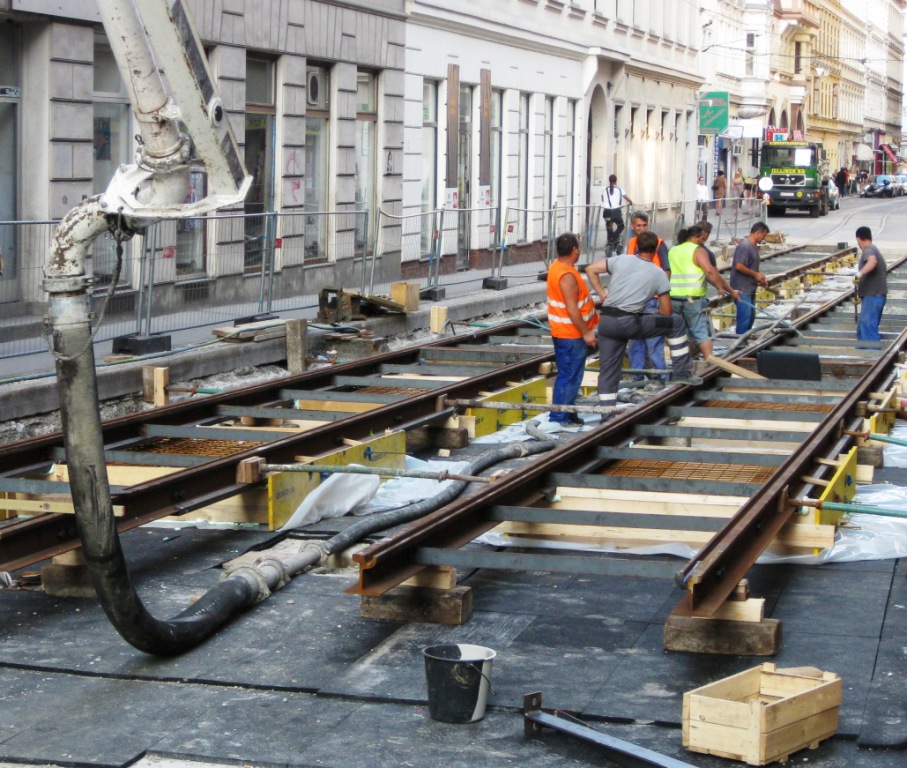
Our local tram (US: streetcar) line has been closed for a little over a week while the Wiener Linien rebuilds the track. The work has been going on for about three weeks (the trams kept running for the first couple weeks) and will continue until early next week.


Track maintenance is a massive undertaking, they started by tearing out everything until they reached the dirt (about 70 cm, 2.5 feet), then they rebuilt it step by step. First repairing the sub-base, next building a new poured concrete track support system, then replacing the tracks and finally placing a new roadway surface (prefabricated sections).

They are working on approximately three blocks this summer, doing one block at a time. The first block is finished, the second is just about finished and they started on the third block yesterday. They are also replacing a shorter section at Westbahnstrasse and Kaiser Strasse which involves a tram line crossing - the photo above is from that construction.

Here's a link to my 230 (so far) Flickr photos of Westbahnstrasse tram track rehabilitation.

I also have been filming some of the action, I will make a website with the best photos and films in the coming months.

Moving Sidewalks: Back to the Future?


There's a great article on the history of moving sidewalks in New Scientist Magazine (thanks to Planetizen).

I think moving sidewalks, or some other type of continuous transport system, would be a great feeder system for regional (US: commuter) rail systems. This would enable the stations to be located a bit further apart in urban areas than in a 'normal' subway system - reducing operating costs and making service on the regional system more attractive (fewer stations = faster). Regional rail systems build with this model could follow the Zürich S-Bahn model, many lines operating through a central section that branch to different suburbs when they leave the center.

An interesting compliment to the moving sidewalk/continuous transport system would be combining it with attractive urban design, in other words give the people traveling on the system something interesting to look at while traveling. I recently had the idea of creating such a system in Abu Dhabi as part of their new Metro project. In this case the continuous system could travel through a traditional Arab linear market street setting. The market street would be protected from the weather in traditional ways, thus reducing energy use. The project would combine 'new' urban development with the transport system. More on this idea later.

Saturday, July 4, 2009

Museum Tauernbahn: Austrian Railway Museum


A couple weeks ago we visited the Museum Tauernbahn Salzburger Eisenbahnmuseum (the Tauern Valley Railway Museum). The museum presents the history of the railway line that connected Salzburg with routes to Trieste (the main port city for the Austrian-Hungarian empire.

The museum is small but quite nice. You can reach it by taking the train from Salzburg to Schwarzach St. Veit - about one-hour trip. The museum is a few steps away from the station. If you come by train they give you a discount (3 Euros instead of 4-5 Euros).

The museum focuses on building the rail line through the alps. It has an old tunnel drilling machine, describes the construction process, the history of selecting the alignment and has a model of one of the worker bedrooms. Outside you can climb on an old locomotive and there is an old maintenance hall with exhibits on the signaling/interlock technology, power distribution and a model "station". Upstairs is a model railway (currently being completed) of the rail line.

The museum is open from May to early October Wednesday, Saturday and Sunday (and some Thursday nights) - check the internet site for details. The descriptions are in German, but the people are very helpful and many of the exhibits are self explanatory.

Here are my flickr photos of Tauernbahn Eisenbahn Museum.

Wednesday, July 1, 2009

Model Trains Anyone?

Wired is having a new contest for people to upload photos of their model trains. We don't have a model train at home, but maybe you do? Here's the link to WIRED Model Trains.

Friday, May 1, 2009

Maintaining London Underground


Here's a great video (well for us subway nerds) from Wired showing some of the work that takes place on the London Underground every night. The video shows some of the maintenance work and really gets across the problems involved in working in such a constrained environment (both in terms of space and time available for maintenance). And I thought we had problems with maintenance at Caltrain ...

Wednesday, April 29, 2009

Railways in Wired's Today in Tech


Wired has a fun blog called This Day in Tech. It describes some invention or idea that was first deployed on the same day sometime in the past. Today's was on the invention of the automatic coupler for railways.

When we talk about how good the European railways are, it's interesting to remember that Europe still uses the old manual method of coupling which makes their railways much less efficient. I heard that Europe was about to change to automatic couplers in the 1970s, but France vetoed the idea for some odd reason. C'est la vie!

Here's a list of some of the other railway related This Day in Tech postings:

Aug. 2, 1873: San Francisco’s First Cable Car Conquers Nob Hill - Describes the first cable car in San Francisco and how the system works.

March 5, 1872: Westinghouse Gives Railroads a Brake - Describes how air brake systems work, the air brake 2.0 reference provides a nice perspective on technological innovation.

Nov. 18, 1883: Railroad Time Goes Coast to Coast - who knew that the idea of standard time started with the railways, but it makes sense when you think about it.

Thursday, April 16, 2009

Rainy Saturday on the Glattalbahn, Zurich


On our recent trip to Zürich we rode the Glattalbahn (German) from Zurich Airport into the center of Zürich. The Glattalbahn is a new rail line that combines aspects of a tram (streetcar, light rail transit) line with regional rail. It operates on the city streets in Zürich and then on its own right of way outside the city.

The Glattalbahn was very carefully planned and has lots of interesting features that you can see in this film including very well designed stations, sensitivity to the environment (tracks laid on grass, lines of trees), including the whole street in the improvement project and connectivity to other public transport. I hope the film does justice to some of these, sorry about the rain!

Sunday, March 22, 2009

My Campaign Poster


Last week I was taking some photos of my office for Alain de Botton's office photo contest - he has just written a book about work called: The Pleasures and Sorrows of Work and I noticed my campaign poster sitting on the couch (we unpacked it and put it there about a year ago). The poster is from 1992 when I ran for election to the San Francisco Bay Area Rapid Transit District (BART) Board of Directors. I received over 30,000 votes, but unfortunately the incumbent received over 60,000. However, I think I had the best campaign slogan: "It takes an engineer to run a railroad."

The campaign was very interesting for me on many levels. I learned the techniques of politics. I learned a lot about what people want from their public transport system. (You might be amazed to learn how many people mentioned broken escalators as a problem - I remember that every time I see a non-functioning escalator today.) Finally, I almost learned to ask people for money, but not quite. In short, I learned a lot of things that they don't teach you in graduate school!

One of my campaign goals was to make the BART Board a non-elected position, filled by people elected to a higher office (i.e. city councilpersons or county supervisors). I say this because, while democracy is great, I think that the people managing public transport systems should have a broader perspective than just transportation. They should be involved with land use decision-making and other aspects of local government.

Saturday, March 7, 2009

Incredible Railway Information Technology Story


In an article entitled How RailCorp's derailing commuter 'apps' the Sydney Morning Herald reports that RailCorp, the railway operator there, has sued independent developers of applications that enable real time schedule data to be read from mobile telephones. RailCorp says that the schedules are out of date and might confuse passengers.

Hmm ... maybe RailCorp should provide up to date schedules?

This is a good example of the types of social and institutional problems preventing railways (and public transport in general) from being as successful as they could be. As ETH Zürich Professor Ulrich Weidmann said in the 2008 IT08.rail conference, railway customers expect a very high level of information since that is what they have in their cars with GIS etc. Just today, the NY Times in Have Smartphone, Can Travel about the latest applications for drivers. If railways don't provide quality information using new technology, they will lose customers.

Fighting new technology and the social systems that grow up around these new technologies (e.g. open source, Web2.0) doesn't work. Just look at how successful record companies have been fighting music downloads. Only iTunes has worked because it makes it easy for users and is based on new technology.

Companies, especially railways, need to embrace new technology and support developers of applications that make their systems better and more attractive to customers. More about information technology in the railway industry in our papers: Can Information Technology Help Rail Play a Greater Role in Preventing Climate Change? and From Engineers to Entrepreneurs: The need for social innovation in high speed rail systems.

Friday, March 6, 2009

Transport Simulation Games - Free

I everyone thinks they are a transportation 'expert'. I mean, how many times have people come up to you at a party and, once you tell them you are a transport planner, say something like, "Why don't they add another lane to Highway 66? That would solve the congestion problem."

Usually at this point I excuse myself to get another glass of wine rather than getting into a discussion about the ins and outs of simply 'adding a lane' or 'running more trains' (yes, transport experts are multimodal!).

Anyway, I just read about two free transport planning simulation games that are available on line. I can't vouch for these games, but they sound interesting. Maybe next time a transport expert starts giving me suggestions for solving transport problems I will refer him (or her) to the site!

Saturday, February 28, 2009

Keep on Truckin!

Freakonomics has a fascinating article today, What Do Truckers Have to Do With Country Music, Food Prices, and Politics?, it's an interview with Shane Hamilton author of Trucking Country, a new book on trucking in the USA. The interview raises several fascinating issues related to the truckers themselves and the future or freight transportation. Here's a particularly interesting quote:

It’s not that truckers aren’t affecting food prices at all — clearly the modern food system is utterly dependent on highway transportation powered by fossil fuel, and the costs of transporting food along that chain are borne by food consumers and taxpayers in the long run. Short-term food-price swings, however, are disproportionately absorbed not by end consumers but by those further “up” the food distribution chain — namely, farmers, wholesalers, and transporters.


Hamilton expects that as fuel prices rise there will be less long distance trucking and more use of railroads. Of course this will take some real re-organization of the way railroads work.

Tuesday, February 24, 2009

Zurich Real Time Public Transport Information


As I have written before, the quality of Zurich's public transport system never ceases to amaze me. We visited last week for the International Association of Railway Operations Research (IAROR) conference and had a chance to catch-up with what they have been doing since we left. The biggest change for me is the real time public transport information systems.


All the new vehicles and most of the old vehicles have been outfitted with television monitors that display the next three stops, travel time to these stops and the final destination. Next to each stop all the connecting public transport lines are listed. That's pretty good, but it gets better.

As the bus or tram approaches a stop where there are connecting public transport lines, a second screen shows the departure time of the connecting lines and displays any delays for the particular line (see below). This gives you time to re-plan your route if something is delayed (although lines are seldom delayed in Zurich!).


The on-vehicle system is complimented by real time displays of bus and tram arrivals at all the main bus/tram stops and many of the smaller ones. The displays are simple and easy to read. These are very common today, but the extent of their deployment in Zurich is noteworthy.

As shown on the photo to the left, real time train information is also available on Zurich's S-Bahn (regional rail network), although the transfer of real time S-Bahn data to the Zurich city buses and trams did not seem to be working yet. It's probably only a question of time, the highly innovative and successful StadtbahnZug! S-Bahn system in Zug Switzerland was experimenting with providing local transit information in the trains several years ago.


I am not sure if Zurich's system is unique, but I have never seen a similar system so it might be. In any case it's an excellent example of providing real time public transport data. It's so good I am working on a parody music video of it, you'll see the video here first!