For Prof Morris, “social development” is an amalgam of four factors: energy use; urbanisation; military capacity; and information technology.Wolf's column focuses on the energy side, but all four factors are fascinating. Morris' book is on my to read list!
Showing posts with label history. Show all posts
Showing posts with label history. Show all posts
Wednesday, January 12, 2011
Martin Wolf: East and West Converge on a Problem
Today's column by Martin Wolf (East and West Converge on a Problem) in the Financial Times discusses a recent book by Ian Morris (Why the West Rules – For Now, Profile Books, 2010). As always Wolf's analysis is very interesting, for example:


Tuesday, June 1, 2010
Rivets are not just for frogs!
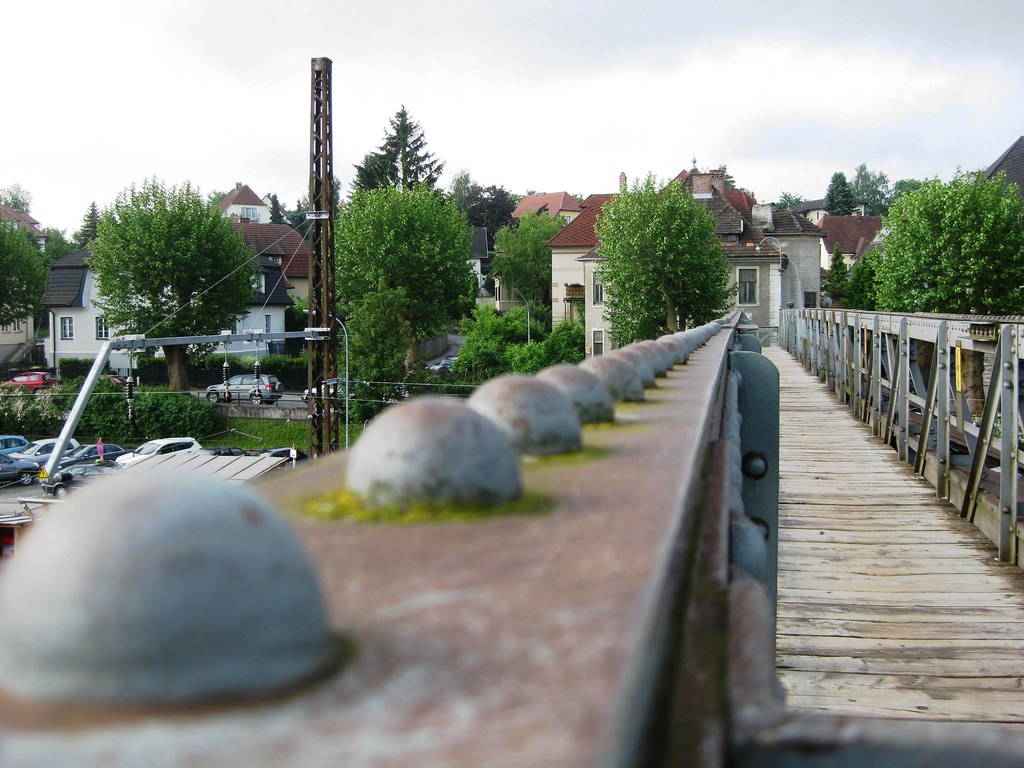
By the way, Grey worked for Bethlehem Steel, my first employer after graduating from RPI. I actually worked in one of the original "Grey" mill facilities in Bethlehem.
Tuesday, March 9, 2010
City Models and Miniatures
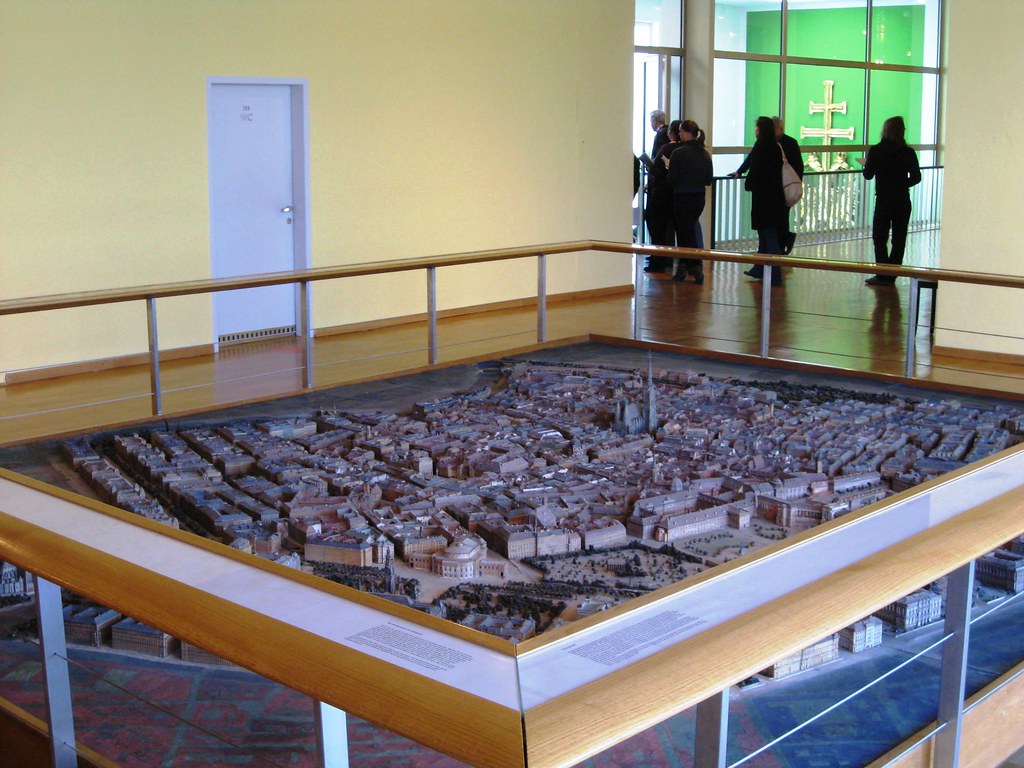
Wien Museum model of Vienna in about 1900 from my flickr photos.
Here's a great post from the Web Urbanist on 22 miniature cities ... different physical and virtual models of cities (I learned about it from Planetizen). I especially loved the film by Sam O'Hara "The Sandpit" at the end of the article.
Here are some more examples of physical models for the list:
- San Francisco - when I studied at the UC Berkeley City and Regional Planning Department Professor Bosselmann had a laboratory with a miniature San Francisco; it was used to model how new buildings fit into the visual environment;
- San Francisco - there is an old model of the city that used to be in the Powell Street BART station ... but I have not seen it in a while.
- Zürich - the planning department has a large model of Zürich today (German) cut into sections mounted on wheels so you can move the sections (they are on tracks) and then walk through a cross section to find yourself in the middle of any neighborhood;
- Zürich - the Zurich city archives museum has a nice model of Zürich around the year 1800, the museum is a delightful place for history buffs and is located on a wonderful square in the old city (try the Neumarkt Restaurant across the street for a nice lunch or dinner).
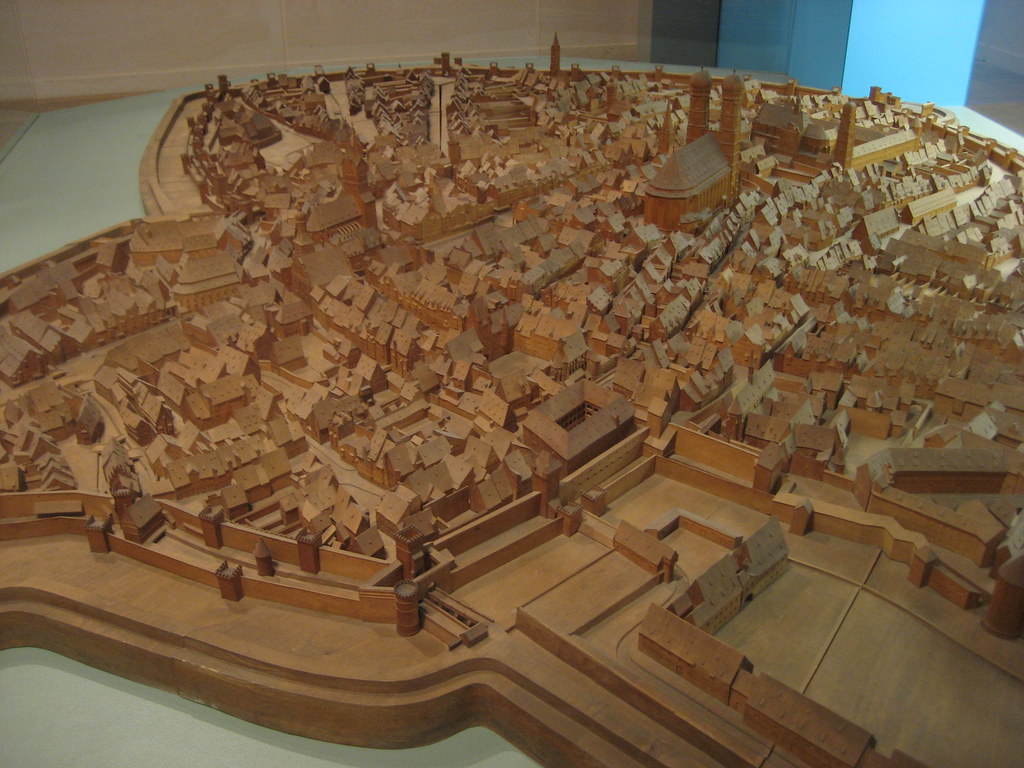
- Munich - the Munich city museum has a model of the city in 1570 and a nice brochure (available in English) about city development (Munich as Planned). The model (shown in photo) is a copy of another model that is in the Bavarian National Museum. The Munich city museum is well worth a visit (have lunch at the Vitualmarkt - one of the greatest urban spaces in the world! - in good weather, try Der Pschorr at night and if the weather is bad).
- Vienna - the Wien Museum (the city history museum) has two models at about the same scale (one on the second floor and one on the third) showing the city in about 1800 and in about 1900 (overview shown above and detail shown at the right). The Wien Museum is well worth a visit, here's a link to my Wien Museum flickr photos set.

Wednesday, April 29, 2009
Railways in Wired's Today in Tech

Wired has a fun blog called This Day in Tech. It describes some invention or idea that was first deployed on the same day sometime in the past. Today's was on the invention of the automatic coupler for railways.
When we talk about how good the European railways are, it's interesting to remember that Europe still uses the old manual method of coupling which makes their railways much less efficient. I heard that Europe was about to change to automatic couplers in the 1970s, but France vetoed the idea for some odd reason. C'est la vie!
Here's a list of some of the other railway related This Day in Tech postings:
Aug. 2, 1873: San Francisco’s First Cable Car Conquers Nob Hill - Describes the first cable car in San Francisco and how the system works.
March 5, 1872: Westinghouse Gives Railroads a Brake - Describes how air brake systems work, the air brake 2.0 reference provides a nice perspective on technological innovation.
Nov. 18, 1883: Railroad Time Goes Coast to Coast - who knew that the idea of standard time started with the railways, but it makes sense when you think about it.
Thursday, April 9, 2009
Burnham Plan for Chicago
2009 is the centenial of Daniel Burnham's plan for Chicago. We studied this plan in all my history of city planning courses, not only the content, which was quite advanced, but the beautiful drawings and associated public relations efforts (they even created a textbook for school children to teach them about the importanace of good city planning and implementing the plan). To celebrate the centenial the Chicago Public Library has created a website: The Burnham Plan Centenial with lots of good information.
Thursday, March 19, 2009
Richard Florida on Bailouts and Stimulus
Richard Florida, one of my favorite 'planner economists' has been writing about the bailouts and stimulus plans on his blog in the last couple days. It's particularly good because he addresses several of the questions that always seem to come up regarding his work "everyone can't be in the creative class, what about the others?" etc.
I am especially concerned that we are wasting a great opportunity to create a more future-oriented economy. We should be using the stimulus to move towards a more environmentally and economically sustainable future. Of course, if we don't someone else is likely to do so, as Florida puts it:
I am especially concerned that we are wasting a great opportunity to create a more future-oriented economy. We should be using the stimulus to move towards a more environmentally and economically sustainable future. Of course, if we don't someone else is likely to do so, as Florida puts it:
The clock of history ticks on. Over time, it tends to leave behind those places who get stuck, get trapped, or try too hard to breathe life back into the old order, neglecting the new one that is emerging. And that’s what really worries me.
Monday, November 10, 2008
A little history of the world by E.H. Gombrich
I just finished reading "A little history of the world" by E.H. Gombrich. Gombrich, then an unemployed Viennese art history graduate, wrote the book in six weeks during 1935. The book was spellbinding, I finished it in a day.
"A little history of the world" was written for young people but it's a book anyone can enjoy. One nice aspect is how it links events through history, eg it explains Bismark's role in German history in the context of Maria Theresa's social reforms in Austria and Karl Marx. While written for young people, it doesn't talk down to them and raises important social questions for us all. The book is short so it's not detailed and it mostly describes European history, but that's its objective. Finally, Gombrich's belief in human Enlightenment and faith in humanity is refreshing.
At the end, Gombrich describes history as a river, we are viewing the river from an airplane, we come closer to the water and see millions of shimmering white bubbles come to the surface and then vanish in time ...
"A little history of the world" was written for young people but it's a book anyone can enjoy. One nice aspect is how it links events through history, eg it explains Bismark's role in German history in the context of Maria Theresa's social reforms in Austria and Karl Marx. While written for young people, it doesn't talk down to them and raises important social questions for us all. The book is short so it's not detailed and it mostly describes European history, but that's its objective. Finally, Gombrich's belief in human Enlightenment and faith in humanity is refreshing.
At the end, Gombrich describes history as a river, we are viewing the river from an airplane, we come closer to the water and see millions of shimmering white bubbles come to the surface and then vanish in time ...
We are like that. Each one of us no more than a tiny glimmering thing, a sparkling droplet on the waves of time which flow past beneath us into an unknown, misty future. We leap up, look around us and, before we know it, we vanish again. ... And what we call our fate is no more than our struggle in that great multitude of droplets in the rise and fall of one wave. But we must make use of that moment. It is worth the effort.
Subscribe to:
Posts (Atom)