Pages

Showing posts with label economics. Show all posts

Friday, March 2, 2012

John Friedmann in Vienna

John Friedmann TU Vienna - 2
Friedmann responding to a question.


It was a great honor to hear Professor John Friedmann speak at the Technical University of Vienna last week. The lecture was fascinating. Here are some of my notes, they are incomplete and the lecture was so full of information that I am sure I got some of it wrong. You can get a copy of the full lecture from the lecture organizer.


Friedmann's lecture was structured around nine Austrian "cultural emissaries" who left Vienna for the outside world and directly influenced his thoughts about planning.


The nine are: economists Bertram Hoselitz, Friedrich Hayek, and Joseph Schumpeter; the sociologist Karl Mannheim; Martin Buber, a philosopher and Judaic scholar; Ludwig Wittgenstein, a philosopher of language; Karl Popper, a philosopher of science; Paul Feyerabend, also a philosopher of science and a critic of Popper; and Karl Polanyi, an economic historian and social anthropologist.

Although Friedmann did not agree with all these thinkers, they all influenced his work.


Studies at the University of Chicago


Friedmann studied planning at the University of Chicago between 1949 and 1955. Four Austrians who influenced him there were:

Planning could be thought of as an intellectual pursuit, not just a profession.
Democratic planning could be a 3rd path between totalitarian fascism and soviet communism.
Planning is a condition for democratic life, the national state could and should intervene in the market for the benefit of society as a whole.
Belief in the possibilites of a constructive democratic planning by the state.

Succession Vienna - 2
Succession Vienna, walking to the lecture.
Friedrich Hayek (The Road to Serfdom)
Social state management is a recipe for disaster.
Strongly opposed to all forms of planning and state intervention.
Planning is a socialist plot.
Hayek's thinking became a model for Margaret Thatcher, his book "a bible she wielded like a battle ax".

Bertram Hoselitz (Economic historian at University of Chicago)
Initiated the multi-disciplinary study of socio-economic development in the US. Founding
editor of the Journal of Economic Development
and Cultural Change (1952).
Focused on the role of cities in economic development: growth pole, world city, urban centered regions.
His work in development studies and the role of cities strongly influenced Friedmann.

Earlier work had been on the theory of economic development.
Innovation in economic production and the idea of entrepreneurship took off from his work.


Friedmann linked this concept to Hannah Arendt's idea of "action" (handeln in German) by which she meant "setting something new into the world." For Friedmann planning is pragmatic or institutional innovation ... not regulation and control (which is simply administration).


Another of Schumpeter's famous ideas is creative destruction, where the old is destroyed to make room for the new. In this sense innovation is a form of insurgency against the status quo. Friedmann links this idea to entropy and negative entropy (dissipation and articulated growth). According to Friedmann, our nerves have, to date, been calmed by the illusion of universal progress (bought about by innovation), but he pointed out that "'development' in most of the world usually comes with a negative sign."


The idea of negative entropy comes from Erwin Schroedinger: What is life? (1944) another Viennese.

Wanderjahre and UCLA


After graduating from the University of Chicago in 1955, Friedmann worked as a development specialist in South America, South Korea and Japan (Ford Foundation, USAID, etc.). He also taught at MIT and in 1969 started teaching planning at UCLA where he remained until 1996. 

Friedmann's book "Retracking America" was published in 1973. It grew out of his experience working on development in South America, it caused him to re-think the idea of planning.
Friedmann's idea: planning is a relationship between knowledge and action, it requires dialog.
A form of utopian planning based on local citizen participation.

Karlskirche Vienna Night - 2
Karlskirche, walking to the lecture.
Martin Buber (Ich und du, 1923)
Friedmann's idea of transactive planning was influenced by the idea of dialogue and mutuality in Buber's book.
He was also influenced by Buber's idea of utopia, but Friedmann believes that utopias need to remain small.
To Friedmann, innovative planning is inconceivable without a utopia in your imagination.

Critical connection between knowledge and action.
Ultimate certainty (truth) is attainable.
To Friedmann planning = a science but also means being actively engaged in making change, so: ... What knowledge is sufficiently reliable for the practice of planning? How do we get it?

Paul Feyerabend 
Started as a student of Popper, but rejected Popper's idea of certain truth.
Anarchist theory of knowledge.
Methods cannot be prescribed, results are what ultimately matters = pragmatism.
Multiplicity of knowledges, no single objective knowledge.
Idea of social or mutual learning.

Ludwig Wittgenstein (multi-talented rebel without a cause)
Friedmann's book "The Good Society" was directly influenced in content and form by Wittgenstein's Tractatus Logico-Philosophicus book.
A foundation of thinking about a form of planning not organized by the state.
Moral basis of social practice, ethics.

Karl Polanyi (The Livelihood of Man 1977, link to review)
Friedmann had returned to the more manageable idea of development planning, particularly in the developing world. During the 1980s the idea of large government intervention in development was being replaced (partly as a result of Thatcherism) by the idea of small NGO-based programs. But NGOs cannot deal with the huge structural problems in many developing countries. It was during this period that development planning lost its scheen.

Polanyi's book described development freed from the language of classical economics, ... "Disposable labor is allocated between the production of use values in the moral economy and exchange values in the capitalist economy." Focused on the household as a social institution rather than a utility maximizing individual. Led Friedmann to the concept of social empowerment and a view of poverty defined as a lack of access to the bases of social power (Empowerment: The politics of alternative development).


Some closing thoughts

National boundaries no longer explain much.
Planning is an innovative activity following Hannah Arendt's definition ... innovation is sending something new into the world.
Planning = the relationship between knowing and acting.
Acceleration of human and social change = the acceleration of local history.
Planning is a dynamic pattern of interacting forces, but it's almost impossible to see these forces.
In China planning is more of a ritual activity rather than a guiding force, change is happening too fast for the existing planning structure to keep up.
Planning theory = part of a theory of socio-spatial change ... planning is normative, but history just goes on.

Questions and Answers

Organized civil society = Friedmann's hope for the future.
A tacit knowing is needed, but how do we get it? To Popper knowledge was 'free floating' somewhere above us, if only we could find it.
But, when we do find it, is it true? We know much knowledge today is generated with a point of view (cigarette company funded health research) ... so, what's the truth?
Our interest as planners is to change the world, not to look for the ultimate truth (where ever this ultimate truth is, we can be sure we won't find it).

Knowledge is related to where we stand, knowledge and belief are closely inter-tied.
There is more than one kind of knowledge, who can dismiss knowledge that is based on experience, or religion?
We need to embrace a plurality of knowledges (note plural) to start a conversation on how to change the world for the better.
Principle of dialog won't go by the wayside.
We need to analyze information to understand its meaning.
To gain knowledge we need to work through the differences.

In a city with many differences we can either give up on the idea of common good and everyone can be out for themselves (pure capitalism) or work through our differences (through dialog with planners acting as facilitators). Note that this is a very different role for planning than Master Planning from on high. Example of Vancouver BC waterfront planning process = extensive resident dialog, it was not a plan dropped on the city from heaven.

Planning must be communications-based - why? It's transactive particularly if you want to add other groups to the dialog beyond the state.
Civil society is key. Friedmann hopes for innovation based on ideas coming from civil society. An analysis of needs with a democratic ethos.
Hope for a better world is to learn to live with in our means (Greece is a good example when we don't live within our means) ... this will mean substantial change in the next 50 years.

Cities will always be unjust. Rapid change always generates inequality ... fighting for the ultimately just city is a losing battle. (For example, the UN Millennial goals: only relevant for a static world, but the world is changing too rapidly for these goals, however good they are today. There will always be new inequalities.)
Patsy Healy, (Newcastle University profile) The pragmatist tradition in planning thought (2009) (abstract)

We need to change the question we ask about cities ... in planning we never have enough knowledge, we are always taking risks because we don't know the future ... we need to act on assumptions and then act again after seeing the results.

We need to be practical and we need to PRACTICE

Social learning is a step by step process, taken by different actors.

And then, suddenly, two hours had gone by ... As you can see there were so many interesting ideas it was hard to record them all accurately. I did the best I could but am sure I got some of it wrong. Feel free to add corrections or thoughts in the comments.


Saturday, February 19, 2011

Rustbelt City Planning

Buffalo City Hall Jun07 - 01
They had a way with words back then.
City Hall Mosaic Buffalo NY (source: Andrew Nash, 2007)

As a city planner who grew up in Buffalo NY I can't help but be interested in how to revitalize Rust Belt cities. My solution: Rustbelt Cities need to be bolder and more creative (DUH.. what city/company/person doesn't need to be bolder and more creative?).

Rust Belt city leaders will say, we are being bold and creative, we're planning a big box store to compete with the suburbs or we're planning a festival marketplace/ convention center/ casino to attract tourists. What's not bold about that?


Buffalo aerial sept08-12
Buffalo waterfront and downtown: looking for a few truly bold and creative ideas.
(Source: Andrew Nash, 2008)

Well, big's not always bold and it's rarely creative. Truly bold and creative ideas are place-based. In other words you can't create a festival marketplace without the festival and you can't build a big box store without the suburban streets and parking.

There's a saying: if you're an apple don't try to be a banana, you'll always be a second-rate banana. It's even worse for a city: if you try to be a suburb you'll destroy what's good about the city (and, you probably won't be successful anyway).

What can cities do? Create the festival and place-based development will follow. Support businesses that fit into the existing infrastructure and complimentary businesses will follow. As anyone who has ever practiced this type of ground-up planning can tell you, developing bold and creative ideas that are place-based is much harder than it sounds.

Gates Circle Buffalo-sept10-4
Buffalo's Omstead-designed park system is a
bold and creative idea that's place-based.
(Gates Circle, source Andrew Nash, 2010)

One of the biggest challenges is that often Rust Belt city leaders are so desperate they'll support anything short of a chemical waste dump (and sometimes even the waste dump). Once leaders embrace an idea anyone opposing it is a NIMBY or against progress.

This "with us or against us" view came to mind when I read the fascinating post the Problem with Boosterism in the Rustwire blog. The post and very thoughtful comments describe how Boosterism can blind people to addressing real city problems.

But, and here I return to my current work, social networks and Web 2.0 technologies can be used to help develop and implement the kinds of bold and creative - but place-based - ideas needed to revitalize Rust Belt cities. It's an exciting period and there's much to learn about how this will work. Some resources I have found who are using social networks and Web 2.0 techniques to help improve Rust Belt city planning include:

  • Rustwire Blog - a group of journalists doing some serious thinking about Rust Belt issues, check out their Blog Roll for more excellent blogs and their flickr group Rustwire for sharing photos.
Buffalo Elmwood May10-02
Elmwood Avenue, Buffalo
(Andrew Nash, 2010)
  • Buffalo Expat Network - this is a really cool idea, mobilizing people with connections to a city (e.g. who have moved away) to generate ideas and support for revitalization; (they have fun too!) ... includes a Facebook social network.
  • GLUE - Great Lakes Urban Exchange - founded in 2007 as a forum for people to exchange stories, ideas, and best practices between otherwise isolated cities ranging from Buffalo to St. Louis to Minneapolis. An excellent platform for learning from each other.
  • PPS - Project for Public Spaces - while PPS does not focus on Rust Belt issues, their approach to "placemaking" is exactly the type of ground-up planning that's needed in Rust Belt cities.
The list is far from complete. Please add more links and ideas in the comments!

I will tag future posts on Rust Belt city planning: Rust Belt Cities.
Several of my previous posts tagged Buffalo also deal with Rust Belt city planning ... I think some are bold ideas - like tearing down a couple of freeways. Finally, here's  a link to all my Buffalo flickr photos.

Wednesday, January 12, 2011

Martin Wolf: East and West Converge on a Problem

Today's column by Martin Wolf (East and West Converge on a Problem) in the Financial Times discusses a recent book by Ian Morris (Why the West Rules – For Now, Profile Books, 2010). As always Wolf's analysis is very interesting, for example:
For Prof Morris, “social development” is an amalgam of four factors: energy use; urbanisation; military capacity; and information technology.
Wolf's column focuses on the energy side, but all four factors are fascinating. Morris' book is on my to read list!

Sunday, February 28, 2010

Benefits of High Speed Rail

I just read an interesting article on high speed rail that takes a more comprehensive look at the benefits of high speed rail ... it's not just travel time savings, but what these make possible for the economy. The article presents a very nice analysis by the University of Toronto's Martin Prosperity Institute. Here it is High Speeds, High Costs, Hidden Benefits: A Broader Perspective on High-Speed Rail.

Wednesday, January 27, 2010

What Is Living and What Is Dead In Social Democracy? Tony Judt

 
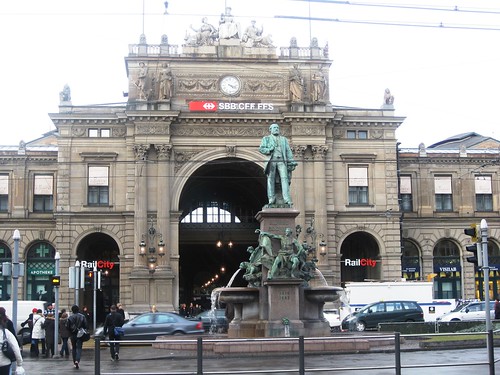
Zurich's Hauptbahnhof - A great example of a main train station (from my flickr photos).

I just finished reading Tony Judt's fascinating article What Is Living and What Is Dead In Social Democracy? from the New York Review of Books (December 19, 2009).

The article is especially interesting to me because is uses transportation, particularly privatization of transport services, as an example to explain the need for considering social benefits rather than very strict adherence to market-based economic considerations. Judt's example of private shops in a public railway station is excellent.

I read about the article in the equally interesting opinion article The Public Works by Nancy Levinson in Places. The article outlines how some of Judt's ideas could be thought about by designers (architects, engineers, and planners).

Friday, December 11, 2009

Dynamic Pricing

What an interesting post by Seth Godin on dynamic pricing yesterday, here's the final line:
Technology puts a lot more pressure on your imagination and creativity, even in pricing.

Thursday, August 13, 2009

Krugman on the Future

Today Paul Krugman, in his blog, links to an article he wrote in 1996 on the future. He specifically addresses the question of technology making workers obsolete. Here's the link to White Collars Turn Blue by Paul Krugman.

Saturday, June 6, 2009

Saving money with dogfood?

Tim Harford is a great source of practical information based on economic research. Today he reports on a experiment where participants were given six "pates" ... well, two real pates, two cheap ones and two made from dogfood. Read the results in Tim's FT column Dear Economist: Should I eat cheap food to save money?.

Saturday, May 30, 2009

A failure to adapt: demographic problems to newspapers

Tim Harford has a nice column in the FT today It’s time to stop being shy about retiring – we can’t afford it about the "problem of demographics". As he puts it,
An ageing society is not, primarily, a demographic crisis. The problem is a failure to adapt – a failure that afflicts politics, management and society.

It's interesting because this failure to adapt is also true of so many other things. For example, in the railway industry it's not the lack of new technology that's the problem in many cases, it's the institutions that fail to adapt effectively to the new technologies. Slate's Jack Shafer in (The Beginning of the End for Newspapers) describes a similar failure of newspapers to adapt to new markets in the 1960s, with the results being felt in today's newspaper crisis.

Friday, May 29, 2009

Bethlehem Casino

My first professional job was as a management trainee at Bethlehem Steel in Lackawanna NY (just outside Buffalo). In June 1981 I was transferred to the Bethlehem Pennsylvania plant, since the company was closing my plant. I lasted about 8 months in Bethlehem before moving on to Boston and Northeastern University. So, I read with interest this story from the NY Times about a new casino that just opened in Bethlehem to take the place of the steel plant. Buffalo also has just opened a new casino - they tore down one of the city's historic grain elevators to build it - that city leaders hope will benefit the economy, but one wonders how large the market for casinos really is and what the real spill-over economic benefits will be as the number of casinos increases.

Wednesday, May 20, 2009

Mathmatics of Urban Infrastructure


Steven Strogatz, a professor of mathematics at Cornell University, just blogged about Math and the City in the NY Times. The article is fascinating because he describes mathematical relationships that seem to hold for city size and infrastructure, and how these are similar to those for living organisms. For example, large animals have a smaller circulation system (per unit volume) than small ones, just like large cities have fewer roads (per person) than smaller cities:
The same pattern holds for other measures of infrastructure. Whether you measure miles of roadway or length of electrical cables, you find that all of these also decrease, per person, as city size increases. And all show an exponent between 0.7 and 0.9.

In other words larger cities are more efficient than smaller ones.

Tuesday, May 19, 2009

Carbon Taxes to Reduce Hot Air

Tim Harford, one of my favorite economists, just reviewed David J.C. MacKay's new book Sustainable Energy – Without the Hot Air. MacKay is a Cambridge physicist who analyzes the physics of various renewable energy sources to see how they can help reduce climate change. Short answer: No. But, read the book or Harford's article for the long answer.

Armed with a knowledge of the physics of renewable energy, it is clear as Harford points out:

Dealing with climate change will need many small decisions to be made differently. The government cannot micromanage these. This is why a carbon price, whether set through taxes or emissions permits, is needed. It is not so much a nudge as a shove in the right direction.

Wednesday, April 22, 2009

Future Urban Transport Conference - Days 2 and 3


Yesterday I discussed the academic workshop held at the Future Urban Transport Conference, today I discuss the second two days which were devoted to a wider discussion of issues.

On Monday, we started with presentations from very high level business leaders at AB Volvo, Bombardier Transportation, Volvo Car Corporation and the Swedish Petroleum Institute. They described what their companies were doing in the areas of future urban transport. Next we heard from the Mayor of Goteborg, the Deputy Mayor of Changsha (China) and Kulveer Ranger (Director of Transport Policy for the Greater London Authority). They described how their cities were addressing the issue of sustainable transport and urban planning. The final session discussed 'service' business ideas: urban freight management, Veolia Transport (a major operator of public transport services) and a property developer from Stockholm who described how they redeveloped an old industrial area.

All the presentations were interesting, although I think that the discussion would have been better if the groups were mixed rather than in the "silo" based format. For example it would have been interesting to have the Bombardier's president discuss where and when rail investment is warranted with a policy maker from a developing country in Asia or Africa. Or having the Volvo Cars president discuss with London's transport policy director how to make electric cars a reality (London believes electric car technology is ready for deployment now, it would have been interesting to hear the auto industry's view on that).

On the other hand, the conference was small enough so that we could discuss many of these issues on a one-to-one basis. In fact, I discussed Shai Agassi's very interesting Better Place proposal for deploying electric cars NOW with London's Mr Ranger the evening before over a beer.

We started Tuesday with two videos of James Bond in Bremen. Then four focused discussions of specific research projects sponsored by the VREF. Professor Lisa Schweitzer (University of Southern California) talked about the need to proactively work on development around rail stations in disadvantaged areas. Professor Yves Crozet (University of Lyon) described how to improve accessibility for disadvantaged areas by focusing on slower modes of transport based on a case study of Lyon's BRT line (the case study used a very cool GIS analysis).

Next we heard from Professor Anthony May (University of Leeds) on the results of a quick analysis of transport financing in France, Germany, Great Britain and Japan. What was most surprising was the lack of detailed research in the area of comparing these systems and the high degree of variation. (This would be an excellent subject for my WIKI-based transport knowledge management system, more later.) Finally, Professor Elizabeth Deakin (UC Berkeley), another of my favorite UCB professors, talked about the US transport funding situation. Both presentations included several excellent recommendations for improving the funding process.

In the afternoon a small group of us visited the Volvo Museum and learned a bit more about the Volvo buses. More tomorrow.

Future Urban Transport Conference - Göteborg Sweden


I just returned from the 4th Future Urban Transport Conference held in Göteborg. The conference is sponsored by the City of Göteborg, the Volvo Research and Education Foundations and the Volvo company. (The photo above is of the design on the sides of Göteborg's public transport vehicles - they have a great PT system including a new bus rapid transit line.)

The conference was excellent, blending academic research with public policy and business issues. The first day consisted of presentations from academic researchers. Many were from programs sponsored by the VREF and there was a real diversity of ideas and opinions expressed. The conference website shows the schedule with links to the presentations.

One of the most interesting presentations for me was the keynote by Professor Geetam Tiwari who discussed some of the research done at her institute in New Delhi. Her presentation Public Transport Use - Emerging Issues really made you think about some preconceived ideas about public transport (is a new metro the right solution for cities like Delhi? is public transport really safer than alternatives? what are the real equity issues in transport?).

I also really enjoyed Professor Carlos Daganzo's presentation on A Cheap and Resilient Approach to Eliminating Bus Bunching. Professor Daganzo was one of my teachers at Berkeley and he always amazed me by being able to translate very complex mathematical analysis into practical ideas, and even better, to make them easily understandable. As a public transport rider I feel like I am affected by bus bunching every day and so I hope to work with Vienna Transport to test Carlos' idea on my local bus line. I'll keep you updated.

The third presentation that made a big impact on me was by Professor Harry Dimitriou: Mega transport Projects, Globalization and Private Finance: Emerging Challenges for the 21st Century. The topics he raised are especially topical since many policy makers have been operating under the assumption that private finance (e.g. public private partnerships etc.) are the answer to solving our transport infrastructure problems ... but the private finance model seems to have let us down in the last several years, what does this mean? Among the interesting points he made is that the private sector is not necessarily more efficient than the public sector, that finance companies and government can have very different objectives for their assets (financiers may want to churn the asset to generate short term profits, government wants an efficient and sustainable infrastructure solution), etc. Fascinating ideas extremely relevant for today's problems.

I could go on since there were many other interesting papers and discussions. Tomorrow more on the second two days of the conference.

Thursday, April 2, 2009

Is management the problem?

Henry Mintzberg, a professor of management studies at McGill University in Montreal, wrote a great article America's monumental failure of management on the current economic crisis that takes a broader view of the problem and its causes. He criticizes the Harvard Business School case study approach among other things and mentions a study he did evaluating the performance of 19 "superstar" HBS graduates (10 led businesses that failed miserably, 4 failed more or less and 5 led businesses that were considered successful ... not a great track record).

I would add former US President George W. Bush, another HBS graduate, as perhaps the best example of failed HBS managers and the bankruptcy in the "American" system of management HBS teaches.

Thursday, March 19, 2009

Richard Florida on Bailouts and Stimulus

Richard Florida, one of my favorite 'planner economists' has been writing about the bailouts and stimulus plans on his blog in the last couple days. It's particularly good because he addresses several of the questions that always seem to come up regarding his work "everyone can't be in the creative class, what about the others?" etc.

I am especially concerned that we are wasting a great opportunity to create a more future-oriented economy. We should be using the stimulus to move towards a more environmentally and economically sustainable future. Of course, if we don't someone else is likely to do so, as Florida puts it:

The clock of history ticks on. Over time, it tends to leave behind those places who get stuck, get trapped, or try too hard to breathe life back into the old order, neglecting the new one that is emerging. And that’s what really worries me.

Friday, March 13, 2009

When comedy becomes serious - Jon Stewart vs Jim Cramer


Jon Stewart host of The Daily Show on the Comedy Channel interviewed Jim Cramer from CNBC's Mad Money show last night. A couple weeks ago Stewart said that CNBC, as well as other 'business' oriented TV shows essentially served as cheerleaders for the mindless economic behaviour over the last several years.

Cramer, to his credit I think, agreed to appear on the Daily Show, and Jon Stewart did a fantastic job interviewing him. He nailed his point that journalism is about digging behind the issues, finding out what's going on and pointing out how to improve things - not simply parroting what big CEOs are saying. The clip above is especially devastating - I thought Cramer would start crying after one of the clips.

I don't know what to think when the best journalism today is being done by people like Jon Stewart and the Comedy Channel, but I am glad someone is doing it.

Thursday, March 12, 2009

Something about Buffalo


Sam Newberg (Joe Urban) has an article today There's Something about Buffalo that discusses some of Buffalo's advantages and problems. One thing he likes is the Buffalo City Hall (photos on my Flickr site). I agree, I think it's one of the finest city hall buildings in the world ... really different from the classic style used in so many cities. I guess I just wish that whatever creative spirit was behind selecting that design for a city hall had done more to create a sustainable economic future for the city.

Thursday, March 5, 2009

Web 2.0 Reward System

Josh Bernhof, one of the authors of Groundswell, a book about using Web2.0 applications in business, just wrote an interesting blog piece Will online volunteers transform our economic recovery? on how reward systems are changing from money to more intangible, and I would argue more healthy, things, here's a quote from the article:
Amid the rubble of foreclosures and layoffs, this may just be a little green shoot that transforms the recovery. But in this new economy it will be reputation, support and sharing -- not just money -- that will make the whole thing go 'round.

I think it's always interesting to think of how these Web2.0 approaches will change the economy, Josh's ideas are very nice beginning.

Saturday, February 28, 2009

Keep on Truckin!

Freakonomics has a fascinating article today, What Do Truckers Have to Do With Country Music, Food Prices, and Politics?, it's an interview with Shane Hamilton author of Trucking Country, a new book on trucking in the USA. The interview raises several fascinating issues related to the truckers themselves and the future or freight transportation. Here's a particularly interesting quote:

It’s not that truckers aren’t affecting food prices at all — clearly the modern food system is utterly dependent on highway transportation powered by fossil fuel, and the costs of transporting food along that chain are borne by food consumers and taxpayers in the long run. Short-term food-price swings, however, are disproportionately absorbed not by end consumers but by those further “up” the food distribution chain — namely, farmers, wholesalers, and transporters.


Hamilton expects that as fuel prices rise there will be less long distance trucking and more use of railroads. Of course this will take some real re-organization of the way railroads work.