My latest music video: "The Bus from Curitiba" probably needs some explanation, so here's a little bit about bus rapid transit and then the words with a couple comments.
Bus Rapid Transit and Public Transit Priority
Curitiba Brazil is famous for pioneering the development of Bus Rapid Transit (BRT). In the 1970s the city decided to build a very efficient bus-based public transport network instead of a relatively short section of metro line (which would have cost the same amount of money). The results have been nothing short of fantastic.
Curitiba's BRT system has been replicated throughout the world, although not to the extent that it deserves. Many cities are seduced by the thought of rail-based public transport preferring the sexiness of rail over the benefits of creating a more comprehensive public transport network.
Rail-based public transport is critical in large cities where there is sufficient demand, but I think it's better to build an attractive and efficient public transport network - based on buses - and then replace buses with higher capacity rail lines when necessary rather then building 'starter rail lines' and hoping to attract riders. It's the network that enables people to get 'from everywhere to everywhere' thus addressing the oft heard complaint that "I can't get there with public transport."
For more information on Curitiba see: the great Streetfilms Curitiba video showing the system in operation and describing how it works; Professor Robert Cervero's excellent book The Transit Metropolis (which also describes many other interesting examples of public transport throughout the world); and the wikipedia article Rede Integrada de Transporte.
BRT can be defined as the systematic application of public transport priority techniques. Zurich is a great example of another approach towards systematically applying public transport priority techniques; rather than building any large project Zurich incrementally added improvements that speed-up bus and tram service over the last thirty years thus creating a fast and efficient surface public transport system. You can read more about Zurich in Professor Cervero's book and in some of my publications and on my website improving public transport efficiency.
The Bus from Curitiba - Words and Comments
I visited Curitiba to ride the buses in 1997. The city was extremely pleasant and enjoyable. In addition to the buses I remember a fantastic passion fruit smoothie. Here are the words:
Fast and fun and clean and quickly, The bus from Curitiba comes cruising, And when she comes the people all say ahh ... When she moves she's like a Samba that Rides so smooth and sways so gentle That when she passes each one she passes says ahh ... Oh I would ride her so gladly, If transport planning wern't done so badly, Yes, I would ride her so gladly, But each bus that we put in a plan, Just gets replaced by a tram, Fast and fun and clean and quickly, The bus from Curitiba comes crusing And when she passes I smile But we don't BRT Not in our city, No we just don't BRT.
OK, I am not being totally fair. Planning isn't always done badly, but as I outline above, I think too often we ignore the bus option (of course capital and operating funding programs also enter into the picture, but that's for another song). And, of course, trams make sense in larger cities with strong demand, but gladly and badly is a pretty good rhyme don't you think?
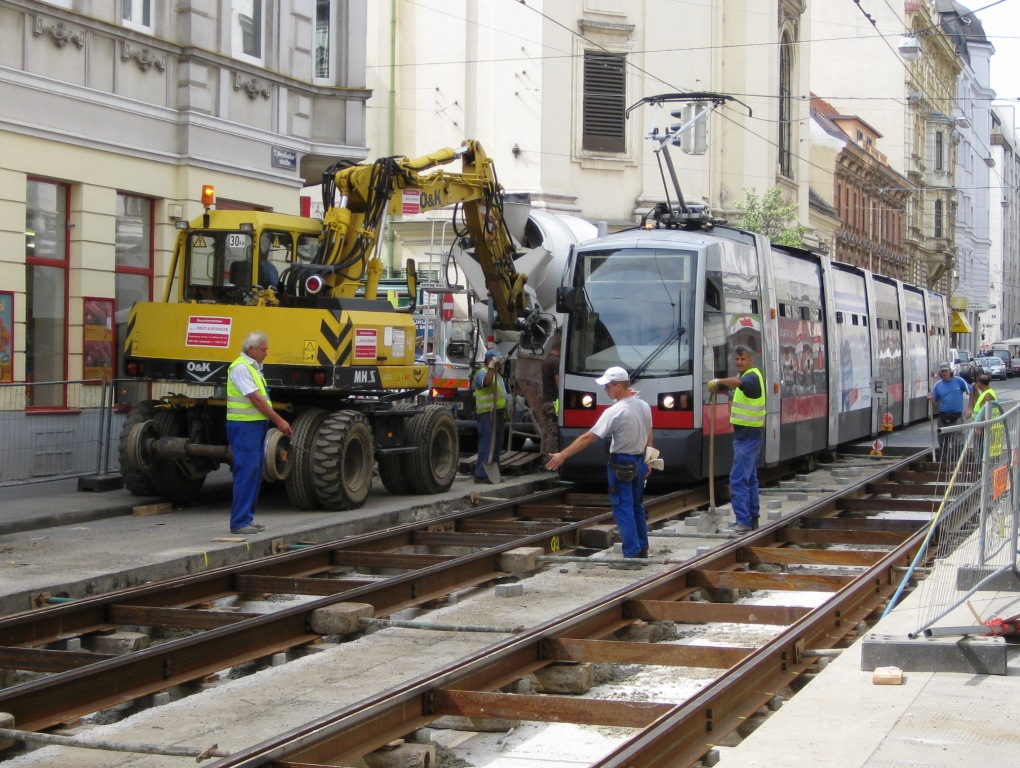
I just finished my series of website pages describing the Westbahnstrasse Tram Track Rehabilitation Project completed during the summer of 2009. The two new pages present aerial views of the work (from a neighbor who was also fascinated by the construction process) and photos of the workshop where the Wiener Linien prefabricate the track by cutting, bending and welding together sections of rail. The website pages include photos, descriptions and YouTube video links.
Now I can get started on this summer's Westbahnstrasse project: the Westbahnstrasse Chronicles! Stay tuned.
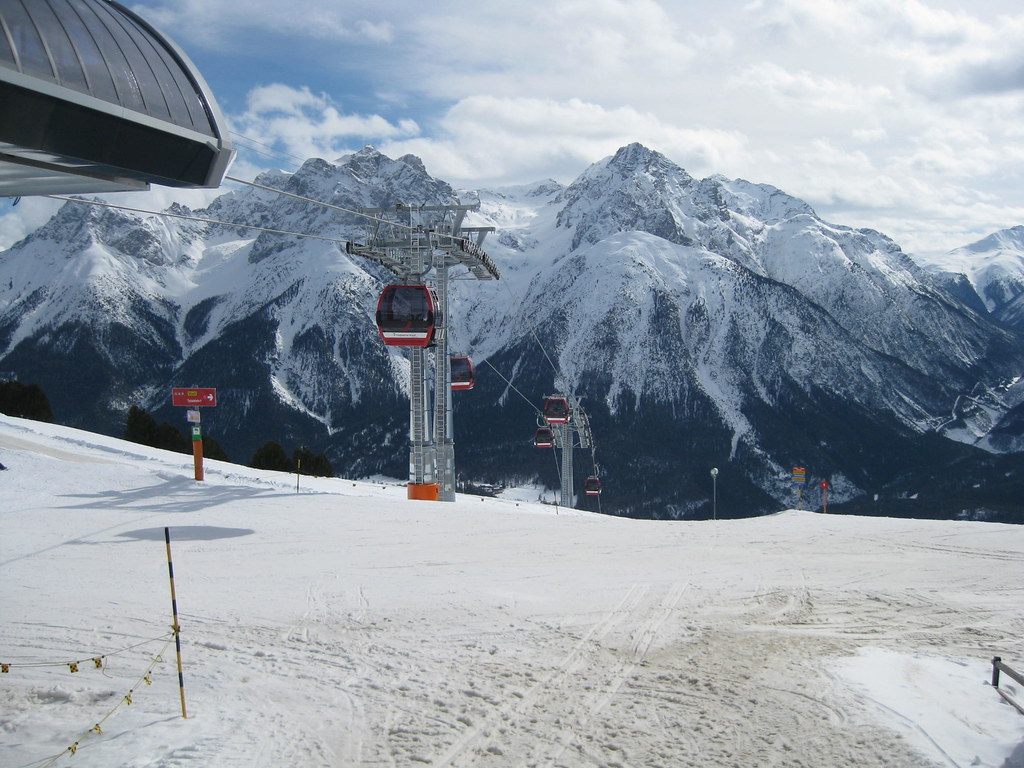
We returned to Scoul, one of our favorite places in Switzerland, for our ski holiday this year. The weather was great and the snow was fine. Scoul is about four hours from Zurich by railway. This post lists some of the reasons we love Scoul.
First, of course, is the Rhaetische Bahn; Scoul is the terminal station (shown in the photo above) at the southeastern end of the Engadine Valley (St Moritz is at the other end of the valley). The Rhaetische Bahn is a narrow gauge railway that serves the canton of Grabunden. It operates the famous Bernina Express and Glacier Express. This is a special year because the Bernina line is 100 years old. Anyway, the Rhaetische Bahn is exactly as you imagine a Swiss railroad: small red trains traveling through a magnificent landscape. If the weather had not been so good we would have taken a few joyrides over the Bernina Pass, but that will need to wait for this summer.
The skiing in Scoul is very good. Switzerland is spoiled for all the wonderful places to ski and Scoul, which would be on the top of the list in any other country, is not as popular as the more famous resorts. But, of course that has the positive side that it's a little less crowded and a little less expensive. The lifts are also a bit outdated (they have several Tee bars and old chairlifts in addition to the brand new gondola and a couple new chairlifts).
Another great reason to go to Scoul is the mineral bath. They have a relatively modern bath complex right in the middle of the town. My favorite part of the bath is the outdoor section with a view of the mountain peaks in the not so far distance (see the photo on their website). You can visit the bath for three hours (bring your own towel) or do something called the Roman-Irish bath, which is a two-and-a-half hour experience of going from sauna to massage to steam bath to different temperature mineral pools, followed by a half-hour rest. We've done both and they are highly recommended. You need to book the Roman-Irish bath in advance, see their website.
Scoul is a tourist destination and there are many places to eat and sleep. The old town down the hill from the main street, has wonderful historic architecture and traditional guest houses. The main street has several historic and modern hotels with all the comforts you would expect in Switzerland.
We have stayed at the Hotel Traube, an historic hotel, the Hotel Curuna, a very nice hotel with a very good breakfast, and Chasa Sofia, a four-room bed and breakfast that is out of this world. All three are located right in the center of Scoul, within five-minute walk of the bath.
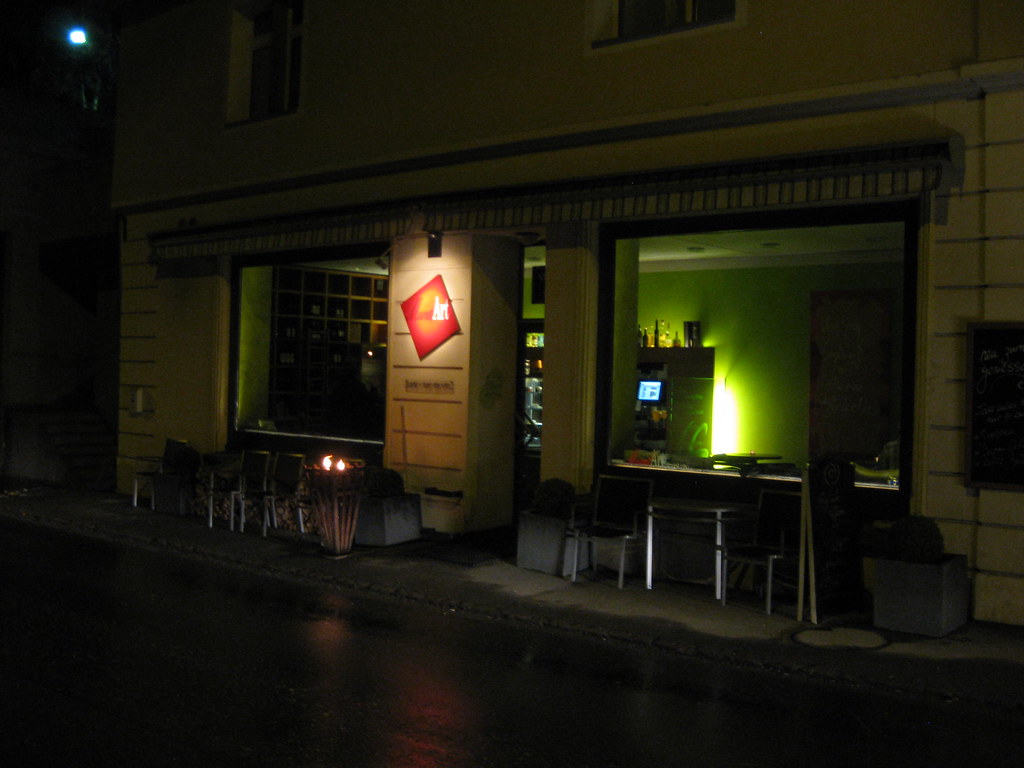
Finally there's lots of great food in Scoul. We visited a wonderful cafe on our trip in February: Mund Art. It's a great place for cake and coffee or a drink anytime (try the local beer: Biera Engiadinaisa). The people are wonderfully nice and friendly, the owner gave us a tasting of his homemade chili pepper syrup.
We had a wonderful dinner at the Hotel Traube restaurant (they also have Biera Engiadinaisa). Their wine list is superb, they probably have 50 different wines from the Canton of Grabunden; we had an excellent Pinot Noir (Blauburgunder) from Annatina Pelizzatti. We all had variations of venison (Wild), either steak (shown in the photo upper left) or stew with spatzele, one of my favorite wintertime mountain village dishes.
Finally, no trip to Scoul would be complete for us without a visit to the Pizzaria Giovanni adjacent to the Hotel Curuna. They have a wood-fired oven, use local organic ingredients where possible and have a wide variety of dishes beyond pizza, but the pizza is great. Service was a little scattered on our visit but the food was fine.
Here's a great video interview of Bill Mitchell, the Smart Cities Director at MIT's Media Lab. They are developing ideas like the cars in the photo above, rethinking the entire concept of cars from technology to the transport systems in which they operate.
I was especially interested in his description of the 'future of mobility' where he talks about the need for sophisticated management algorithms helping to make more efficient use of existing resources (11:15 into the interview). This is exactly the idea behind the Bus Meister concept for using Web 2.0 applications to help provide priority for public transport.
Julia Turner has a great series of articles on signs and wayfinding in Slate. The first article describes the importance of signs in general. The second article takes us on a tour through Penn Station in New York looking at how well (or badly) the signs work in helping us get from an entrance to the Amtrak trains. It reminds me of an experience I had in the Paris Metro Châtelet - Les Halles station in 2008.
The third article is on urban wayfinding, which Turner describes as completely different from wayfinding in transport stations or other controlled environments (e.g. Penn Station). She uses the example of Transport for London's Legible London project to describe the concept. This is a really excellent article filled with lots of good information.
The photo at the right is another solution: people at the Copenhagen Airport who help guide visitors (the other signs there are pretty good too).
The fourth article describes research on the hand-made maps made by normal people. The fifth article describes the 'war over exit signs' which includes a nice summary of the idea behind pictograms and their use on signs. The sixth article is forthcoming, but I am sure it will be good.
I have always been fascinated by signs. Here is a link to my flickr set signs and here is a link to my flickr set WC Signs ... I find wc signs to be especially interesting because they give businesses and people the ability to be creative about how they use graphics. As they say, "You can tell a lot about a place by their WC signs" ... well, at least that's what I always say.
Finally, my restaurant review of the Hallwylerhof restaurant in Zurich. They have a wonderful graphics and signage design used consistently throughout the restaurant, and the food is great too.
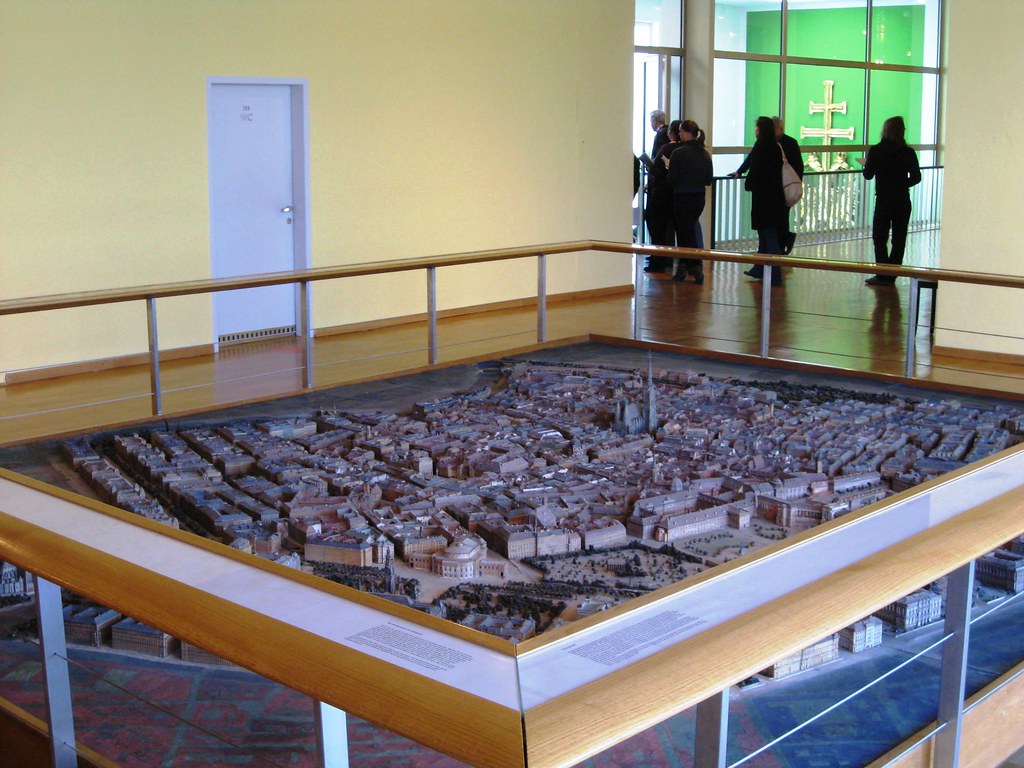
Wien Museum model of Vienna in about 1900 from my flickr photos.
Here's a great post from the Web Urbanist on 22 miniature cities ... different physical and virtual models of cities (I learned about it from Planetizen). I especially loved the film by Sam O'Hara "The Sandpit" at the end of the article. Here are some more examples of physical models for the list:
San Francisco - when I studied at the UC Berkeley City and Regional Planning Department Professor Bosselmann had a laboratory with a miniature San Francisco; it was used to model how new buildings fit into the visual environment;
San Francisco - there is an old model of the city that used to be in the Powell Street BART station ... but I have not seen it in a while.
Zürich - the planning department has a large model of Zürich today (German) cut into sections mounted on wheels so you can move the sections (they are on tracks) and then walk through a cross section to find yourself in the middle of any neighborhood;
Zürich - the Zurich city archives museum has a nice model of Zürich around the year 1800, the museum is a delightful place for history buffs and is located on a wonderful square in the old city (try the Neumarkt Restaurant across the street for a nice lunch or dinner).
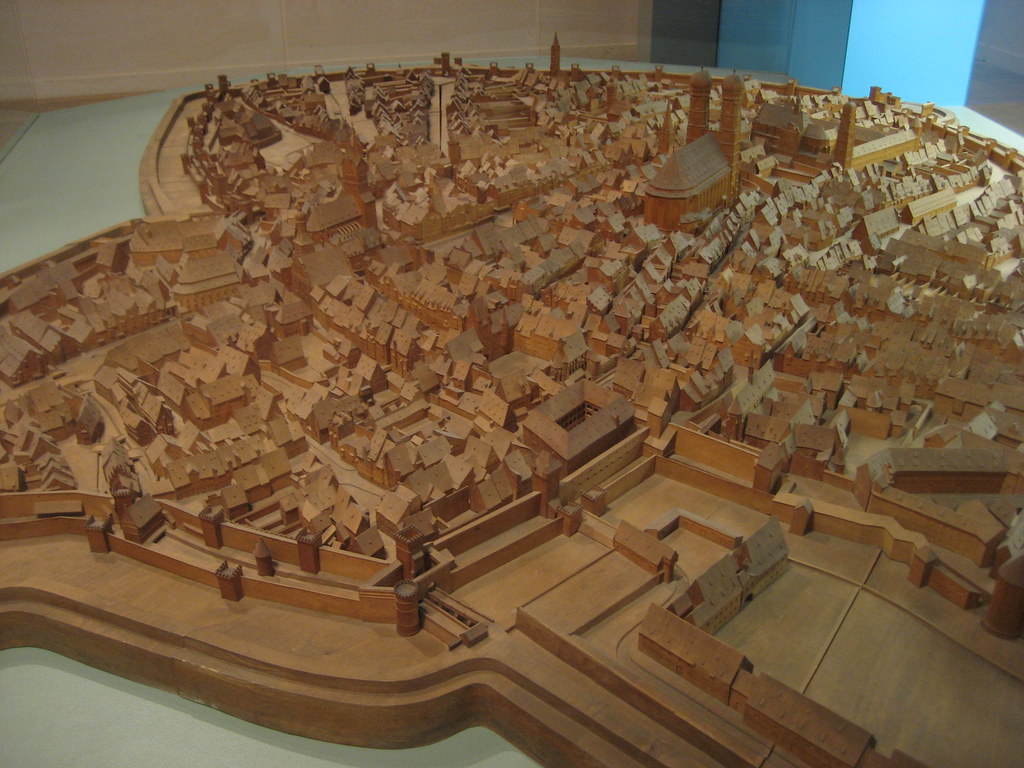
Munich - the Munich city museum has a model of the city in 1570 and a nice brochure (available in English) about city development (Munich as Planned). The model (shown in photo) is a copy of another model that is in the Bavarian National Museum. The Munich city museum is well worth a visit (have lunch at the Vitualmarkt - one of the greatest urban spaces in the world! - in good weather, try Der Pschorr at night and if the weather is bad).
Vienna - the Wien Museum (the city history museum) has two models at about the same scale (one on the second floor and one on the third) showing the city in about 1800 and in about 1900 (overview shown above and detail shown at the right). The Wien Museum is well worth a visit, here's a link to my Wien Museum flickr photos set.