We held our Vienna Linchpin Meetup at the MuseumsQuartier. The highlight was meeting a group of people who wanted to discuss Seth Godin's ideas. On the way home I was amazed to note that three hours had passed, although the fact that they pretty much had to throw us out of the cafe should have been a hint.
We discussed a wide variety of subjects, listed below. We decided to meet again in September to continue our discussion with more people.
Can cleaning people be linchpins? We think that it's possible to bring art to cleaning and cleaners can be an important connection between people working in an office. Our model is not the outsourced cleaning companies, but rather the cleaners who were really part of the organization, like the janitors in our elementary schools in the old days (Mike Mulligan of steam shovel fame). Maybe not forever, but being a linchpin cleaner (to pay the bills) while you are doing some other art at night.
How do you transfer Seth's ideas to old businesses and institutions? An especially important question in cities like Vienna with long traditions.
Can you be a linchpin in a large business or do you need to work for yourself? Of course Seth discusses this, but it was on our minds. We felt that learning to get along in existing structures can provide you with the freedom to implement innovative ideas. But, it's a balancing act.
We should always ask, "Where's the fun?" at work. Work should be a playground where you can fail. Interestingly some organizations allow failure but sweep it under the carpet preferring to ignore it rather than learn from it.
What about colleagues to whom work is simply 8 hours plus a paycheck?
Finally, as a mixed German and English speaking group, we had a lot of fun translating and debating how to interpret Seth's work (starting with "What does linchpin mean?") in another language.
Bus Meister will help citizens lobby city hall (this is Vienna) in support of public transport priority (from my flickr photos). I just returned from a meeting in Udine (Italy) where I spoke about my Bus Meister idea of creating an integrated suite of web applications (game, social network and wiki best practices library) to help educate citizens on how to improve public transport operations (by introducing public transport priority measures) and to empower them to help actually implement these ideas. It's a general approach that I think could be used to solve many urban problems.
Going through my e-mail I was glad to read about Barcelona's new BRT lines which one of my UC Berkeley professors, Carlos Daganzo, is helping plan. The article in the ITS Berkeley News is a very good summary of for the importance of public transport priority and BRT. Daganzo is a brilliant scientist, it's great to see him working on improving public transport!
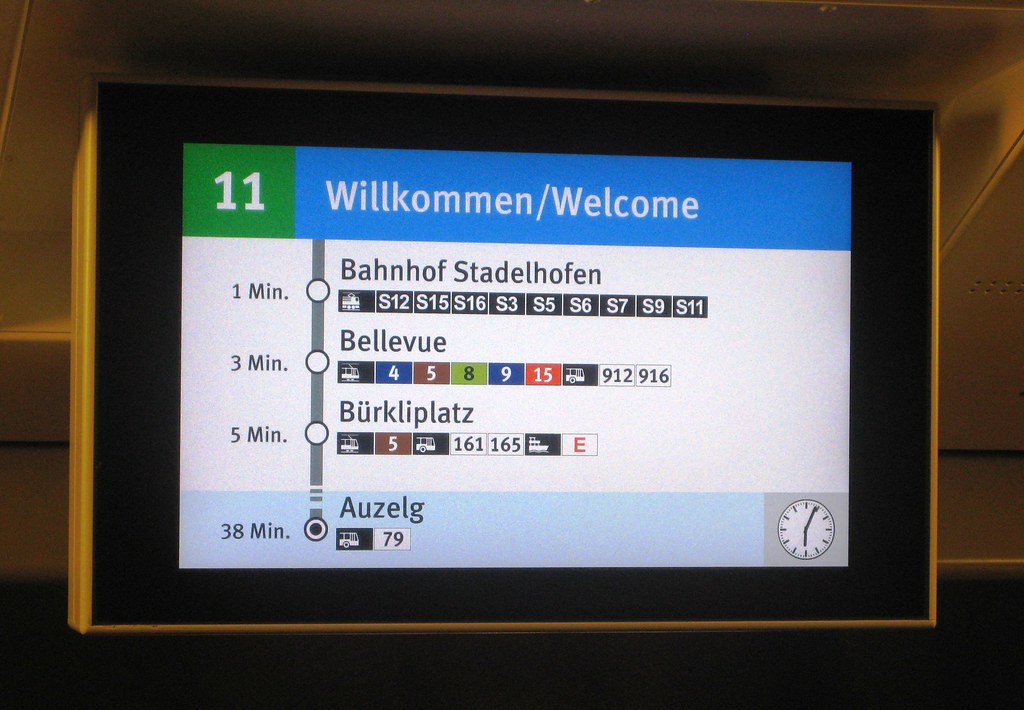
Schedule information screens on Zurich public transport vehicles, from my flickr photos.
The Infrastructuralist just had an interesting article about IBM's Smart Cities program and some work they are doing in Viet Nam. I added a comment suggesting that a good solution for many urban problems is the use of Web 2.0 techniques to involve the public in planning and operating urban services. Read the article and my comment here.
Here's a photo from my visit to the Melk Monastery. A broom standing in front of the garden pavilion (link to photo from my flickr photos). It got me thinking about the need to clean up all that oil in the Gulf of Mexico, Robert Reich has a good article with suggestions.
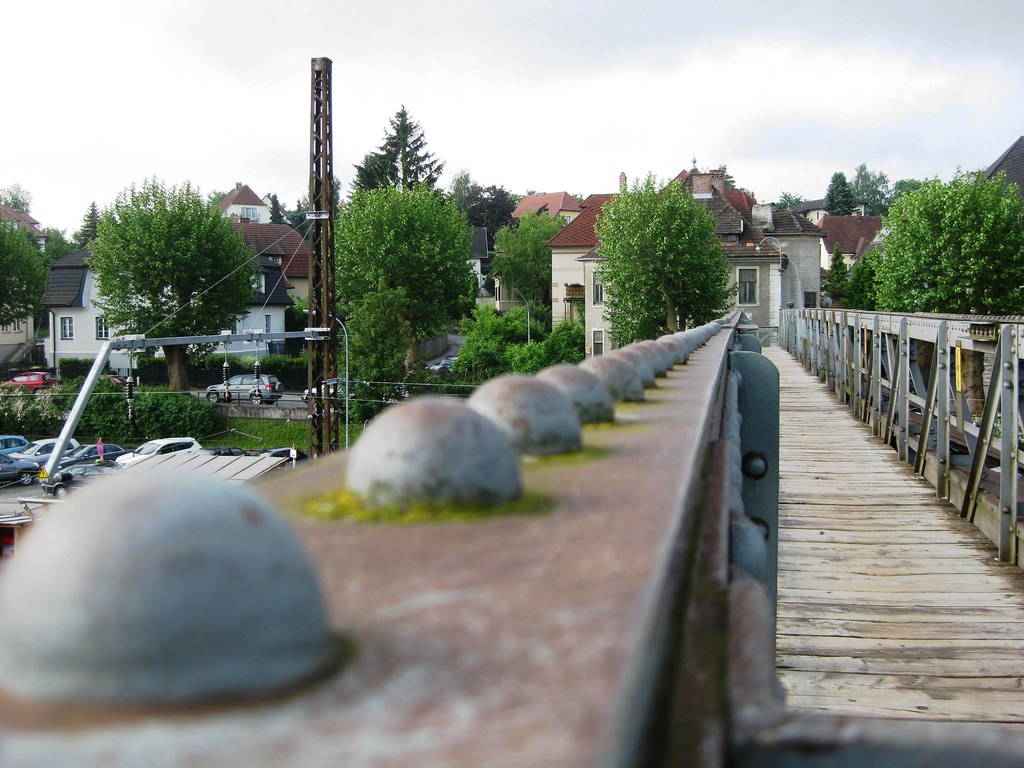
One of my civil engineering professors at RPI used to always talk about the 'built up' columns in the New York City subway stations. The "I" beam shape is very strong and efficient, but it was impossible to make "I" beams directly before the 1908 when a man named Henry Grey invented a mill machine that could roll the shape. So steel workers needed to build their own "I" beams in the field by joining steel plates with rivets. I was reminded of my civil engineering studies when I visited Melk last week and used the pedestrian bridge to cross the tracks.
By the way, Grey worked for Bethlehem Steel, my first employer after graduating from RPI. I actually worked in one of the original "Grey" mill facilities in Bethlehem.
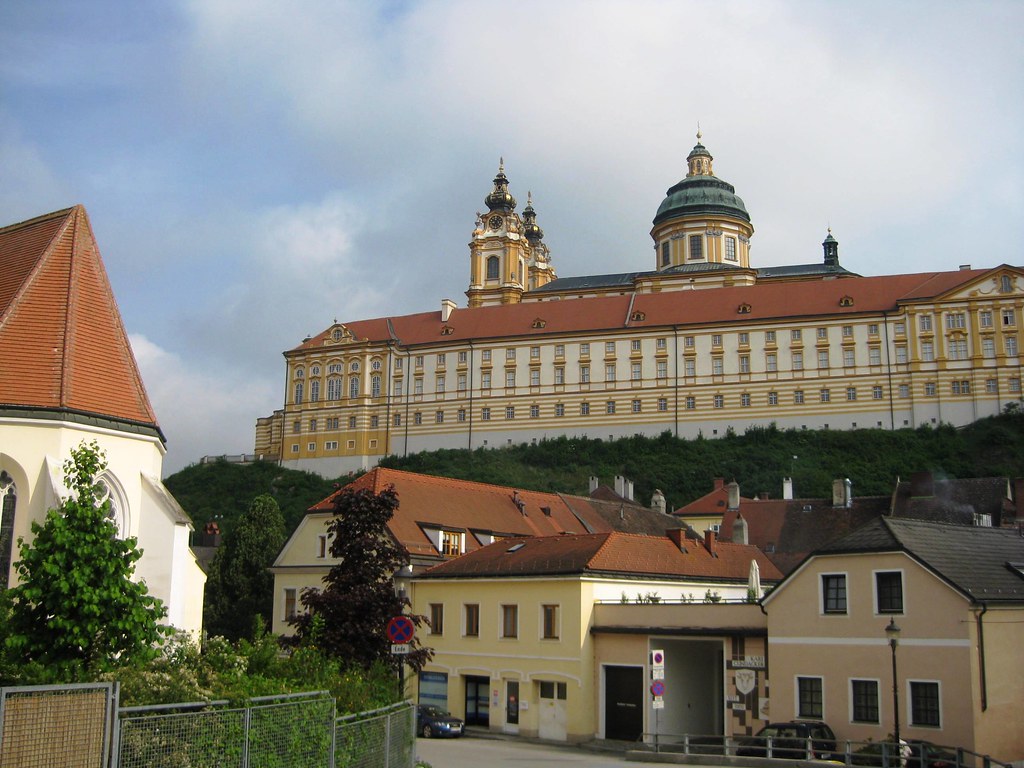
The Benedictine Monastery in Melk is a UNESCO World Heritage site about 90-km from Vienna so I wonder what has taken me so long to get there. All photos are from my flickr set Melk Monastery (lots more photos there!).
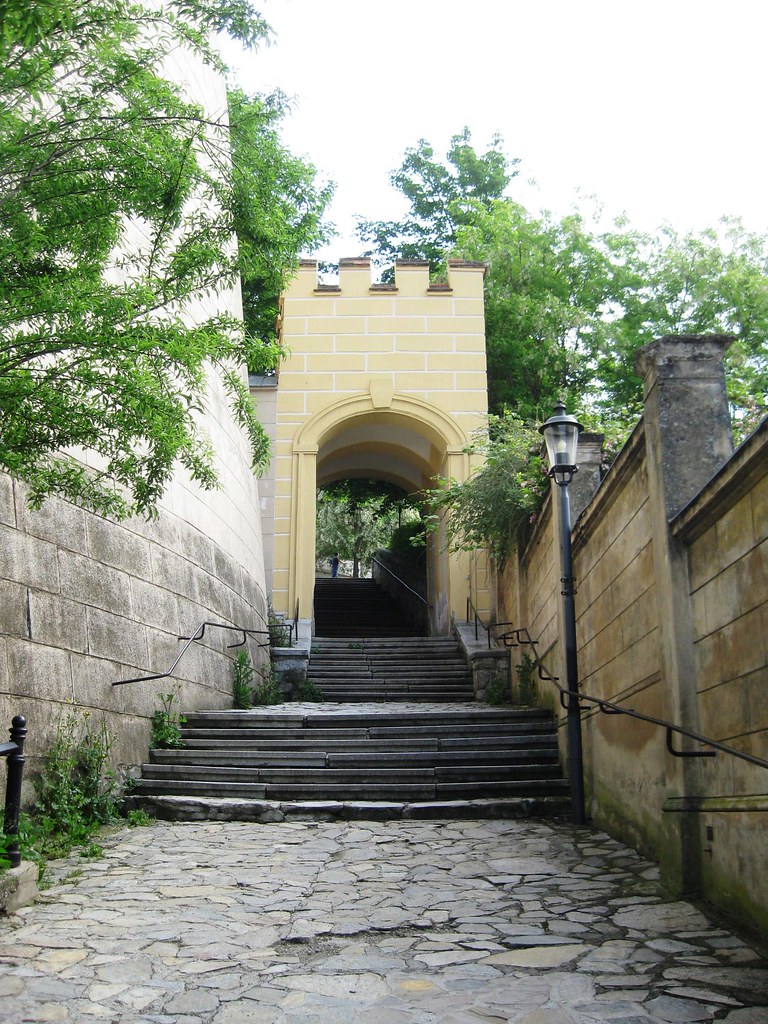
 I took the train and got there at 9 am. It was an easy walk from the train station through a pedestrian district where a farmers market was just being set-up. There is a stairway from the pedestrian street which leads up the hill to the Monastery gate. You buy your tickets at the second courtyard; my ticket was for an English tour at 10:55, so I had some time. (The ticket cost 9.50 Euros.)
I went into the museum where the guard marked my ticket so that I could go in again with my scheduled tour. Even at this early hour there were many groups of visitors from Danube river tour cruise ships (Melk is located on the Danube and is a popular stopping point for river cruises). By staying in between the tour groups I had the museum rooms to myself for a few minutes. It's a very interesting exhibit of the Monastery history combined with the history of the Dominican order of monks.
At the end of the museum is the marble hall which has a beautiful trompe de oeil painting of main characters from Greek mythology on the ceiling (most of the marble is painted stucco, by the way). Leaving the marble hall you walk out on a curved walkway overlooking the church on the one side and the Danube river valley on the other.
The walkway leads to the Monastery library, a treasure house of old books and ideas. Only two of the rooms are open to the tourist public, but the other rooms are accessible to scholars. A flight of circular stairs takes you down to the ground level and the entry to the church.
The Melk Monastery is famous because the whole complex was built at the beginning of the 1700s, and is all in the Baroque style. The church is where the Baroque really lets loose. It's almost impossible to do justice to the space with a photograph. My early visit was quite nice because I was almost alone in the church (at 11:45 the church was almost full with tourists).
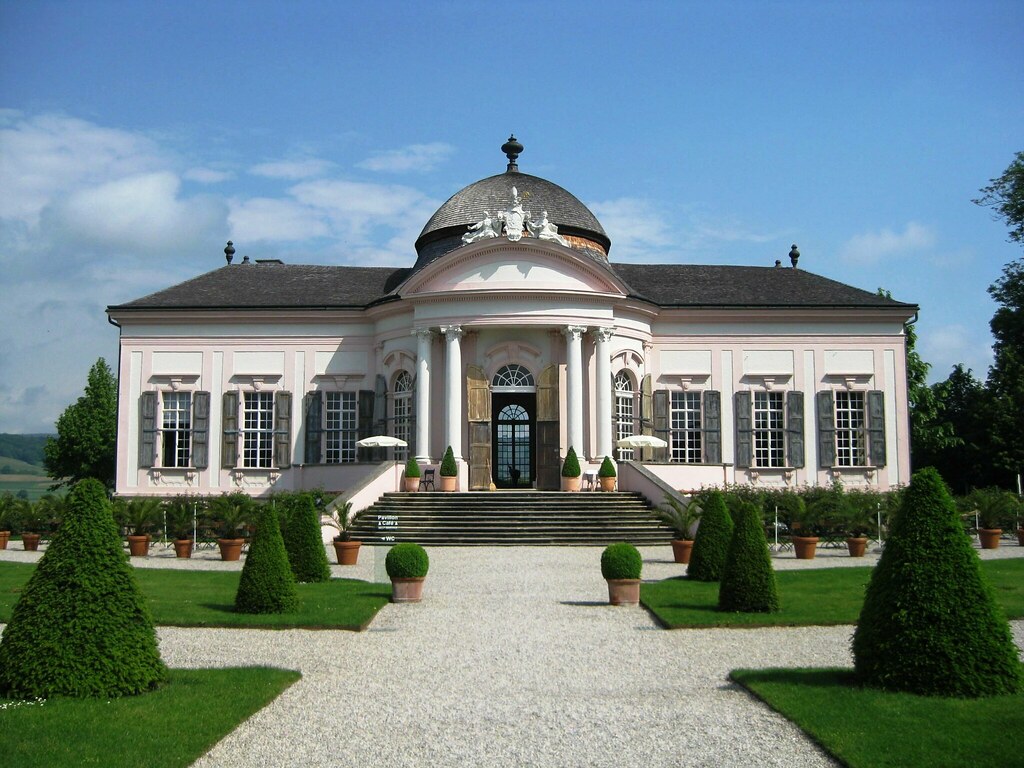
After leaving the church I visited the Monastery garden with its very nice garden lodge - cool frescoes - and took a walk down the garden path overlooking the Danube. Then it was time for my tour. The tour guide was excellent, he spoke very good English and knew his stuff.
After the tour I was hungry and had a nice lunch of Schweinsbraten and beer at the Monastery restaurant located just outside the main monastery buildings on the way to the parking area. The food was quite good and the service was very good (fast, friendly and efficient). My lunch cost 14 Euros.
I took the train and got there at 9 am. It was an easy walk from the train station through a pedestrian district where a farmers market was just being set-up. There is a stairway from the pedestrian street which leads up the hill to the Monastery gate. You buy your tickets at the second courtyard; my ticket was for an English tour at 10:55, so I had some time. (The ticket cost 9.50 Euros.)
I went into the museum where the guard marked my ticket so that I could go in again with my scheduled tour. Even at this early hour there were many groups of visitors from Danube river tour cruise ships (Melk is located on the Danube and is a popular stopping point for river cruises). By staying in between the tour groups I had the museum rooms to myself for a few minutes. It's a very interesting exhibit of the Monastery history combined with the history of the Dominican order of monks.
At the end of the museum is the marble hall which has a beautiful trompe de oeil painting of main characters from Greek mythology on the ceiling (most of the marble is painted stucco, by the way). Leaving the marble hall you walk out on a curved walkway overlooking the church on the one side and the Danube river valley on the other.
The walkway leads to the Monastery library, a treasure house of old books and ideas. Only two of the rooms are open to the tourist public, but the other rooms are accessible to scholars. A flight of circular stairs takes you down to the ground level and the entry to the church.
The Melk Monastery is famous because the whole complex was built at the beginning of the 1700s, and is all in the Baroque style. The church is where the Baroque really lets loose. It's almost impossible to do justice to the space with a photograph. My early visit was quite nice because I was almost alone in the church (at 11:45 the church was almost full with tourists).
After leaving the church I visited the Monastery garden with its very nice garden lodge - cool frescoes - and took a walk down the garden path overlooking the Danube. Then it was time for my tour. The tour guide was excellent, he spoke very good English and knew his stuff.
After the tour I was hungry and had a nice lunch of Schweinsbraten and beer at the Monastery restaurant located just outside the main monastery buildings on the way to the parking area. The food was quite good and the service was very good (fast, friendly and efficient). My lunch cost 14 Euros.
H.H. Richardson: Buffalo State Hospital main building from my flickr photos.
On my recent trip to Buffalo I visited the Buffalo State Hospital grounds in an early, jet-lag induced, walk. Some of my photos are on my Buffalo flickr set tagged with H.H. Richardson: Buffalo State Hospital.
As I grew up the imposing main building (in the photo above) seemed always to be in view. We lived nearby and went to elementary school on the campus of the adjoining state college. It's a fantastic building, unfortunately it really seems to need repair.
Francis R. Kowsky, a Buffalo architectural historian, wrote a nice description of the complex and its history in 2000, it is reprinted on the web page Buffalo as an Architectural Museum: A Towering Masterpiece: H.H. Richardson's Buffalo State Hospital.